
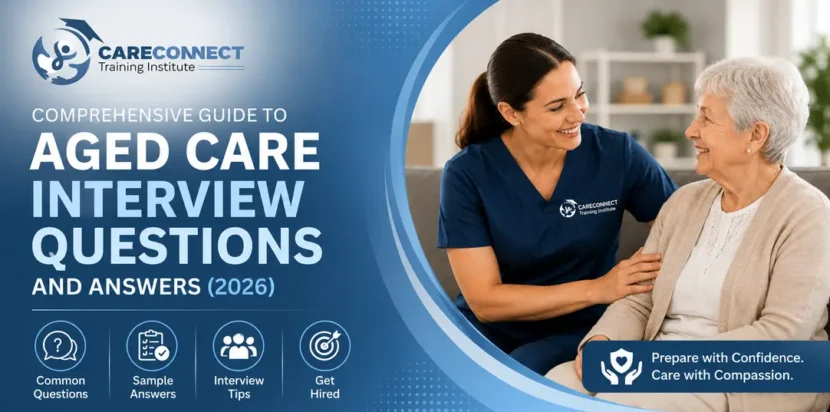
Preparing for aged care interview questions is one of the best ways to improve your chances of securing a job in Australia’s growing aged care sector. Employers want more than qualifications—they want candidates who can demonstrate empathy, communication skills, professionalism, and a genuine commitment to delivering person-centred care.
Whether you’re applying for your first role after completing a qualification or you’re an experienced care worker looking for a new opportunity, understanding the types of questions employers ask can help you answer with confidence. Most interviews assess your motivation, practical knowledge, problem-solving skills, teamwork, and ability to provide safe, high-quality care for older Australians.
If you’re still exploring the profession or wondering what qualifications, skills, and career pathways are involved, read our complete guide on How to Become an Aged Care Worker in Australia before preparing for interviews.
In this guide, you’ll learn:
- How aged care interviews are structured
- The most common aged care interview questions
- Sample answers using the STAR (Situation, Task, Action, Result) method
- Practical and behavioural interview questions
- How to prepare before interview day
- Expert tips to help you stand out from other applicants
By the end of this guide, you’ll have the knowledge and confidence to perform well in your next aged care job interview.
Introduction to Aged Care Interviews
An aged care interview helps employers assess whether you have the right combination of technical knowledge, practical skills, and personal qualities to care for older people safely and respectfully.
Unlike interviews in many other industries, aged care interviews focus heavily on your values, behaviour, and communication style. Employers want to know how you respond in real-life situations involving residents, families, and colleagues.
During your interview, you may be asked about:
- Your previous work experience
- Your understanding of person-centred care
- Dementia care
- Personal care procedures
- Infection prevention and control
- Communication skills
- Teamwork
- Conflict resolution
- Time management
- Emergency situations
- End-of-life care
Many employers also ask scenario-based questions to understand how you would respond under pressure while maintaining residents’ dignity, safety, and wellbeing.
Preparing thoughtful answers before the interview helps you communicate clearly and confidently.
Understanding the Interview Format
Most Australian aged care employers follow a structured interview process. Although every organisation is different, interviews generally include five types of questions.
1. Motivation Questions
Interviewers first want to understand why you’ve chosen aged care as a career.
Typical questions include:
- Why do you want to work in aged care?
- What motivates you to support older people?
- Why did you apply for this role?
These questions help employers assess your passion, values, and long-term commitment to the profession.
2. Experience-Based Questions
If you have previous experience, you’ll likely be asked about your responsibilities and achievements.
Examples include:
- Tell us about your previous aged care experience.
- Describe a challenging resident situation.
- What practical skills have you developed?
If you’re new to aged care, you can discuss your practical placement, volunteer work, or transferable skills from previous employment.
3. Behavioural and Scenario Questions
Behavioural questions are common because they show how you think and act in real workplace situations.
Examples include:
- How would you handle an aggressive resident?
- What would you do if two residents needed assistance at the same time?
- Describe a conflict you resolved with a colleague.
These questions allow employers to evaluate your judgement, empathy, and problem-solving skills.
4. Practical and Safety Questions
Safe care is a priority in every aged care workplace.
Interviewers may ask questions about:
- Manual handling
- Infection prevention and control
- Medication assistance
- Documentation
- Care plans
- Falls prevention
- Resident safety
Employers want confidence that you understand workplace procedures and follow organisational policies.
5. Communication and Teamwork Questions
Providing quality aged care requires close collaboration with nurses, support workers, allied health professionals, residents, and families.
Expect questions such as:
- How do you communicate with residents living with dementia?
- Tell us about a time you worked successfully in a team.
- How do you manage disagreements with colleagues?
Strong communication skills are highly valued across all aged care roles.
Types of Aged Care Jobs
Although interview questions often overlap, employers tailor some questions to the specific position you’re applying for. Understanding the responsibilities of your role will help you prepare more relevant answers.
Personal Care Assistant
A Personal Care Assistant (PCA) provides direct support with everyday activities while helping residents maintain their dignity and independence.
Typical responsibilities include:
- Personal hygiene
- Dressing and grooming
- Mobility support
- Meal assistance
- Documentation
- Emotional support
- Observing changes in residents’ health
Interviewers often ask questions about compassion, communication, manual handling, and personal care experience.
Disability Support Worker
Although disability support and aged care are different sectors, many employers recruit workers with skills that apply across both industries.
Disability Support Workers may assist clients with:
- Daily living activities
- Community participation
- Personal care
- Behaviour support
- Medication assistance
- Goal planning
Interview questions often focus on independence, person-centred support, communication, and problem-solving.
Home Care Assistant
A Home Care Assistant supports older Australians who choose to remain living independently in their own homes.
Daily duties may include:
- Domestic assistance
- Meal preparation
- Personal care
- Shopping
- Transport
- Social support
- Medication reminders
Because Home Care Assistants often work independently, interviewers look for strong organisational skills, reliability, and effective communication.
Lifestyle Coordinator
A Lifestyle Coordinator plans activities that promote residents’ physical, emotional, and social wellbeing.
Responsibilities commonly include:
- Group activities
- Exercise programs
- Community outings
- Music therapy
- Cultural celebrations
- Recreational activities
Interview questions usually assess creativity, organisation, communication, and the ability to engage residents with different interests and abilities.
Why Employers Ask Behavioural Questions
Many aged care interviews include behavioural questions because past behaviour often provides insight into how you’ll perform in future situations.
Instead of asking what you know, employers want to understand how you’ve applied your knowledge in practice.
For example, you may be asked to explain how you:
- Supported a resident living with dementia
- Managed competing priorities during a busy shift
- Resolved conflict with a colleague
- Responded to a medical emergency
- Comforted an anxious resident
- Communicated with concerned family members
The strongest answers are specific, structured, and based on real experiences. Later in this guide, you’ll learn how to use the STAR (Situation, Task, Action, Result) method to organise your responses and demonstrate your skills effectively.
Common Aged Care Interview Questions and Sample Answers
Most aged care interviews include a mix of general, behavioural, practical, and scenario-based questions. Employers want to understand not only what you know but also how you apply your skills when caring for older people.
Below are some of the most common aged care interview questions, along with guidance on what employers are looking for and example answers you can adapt to your own experience.
1. Tell Me About Yourself
This is usually the first question in an interview. It’s your opportunity to introduce yourself professionally and make a positive first impression.
What the interviewer wants to know
- Your background
- Relevant qualifications
- Practical experience
- Why you’re interested in aged care
Sample Answer
“I recently completed my Certificate III in Individual Support (Ageing), where I developed practical skills in personal care, infection control, communication, and person-centred care. During my work placement, I supported older people with daily living activities and learned the importance of treating every resident with dignity and respect. I’m passionate about helping older Australians maintain their independence, and I’m excited about the opportunity to contribute to your team while continuing to develop my skills.”
Keep your answer to about one to two minutes and focus on experience that directly relates to the role you’re applying for.
2. Why Do You Want to Work in Aged Care?
This is one of the most common aged care interview questions.
What the interviewer wants to know
They want to understand your motivation and whether you’re genuinely interested in supporting older people.
Sample Answer
“I enjoy helping others and making a positive difference in people’s lives. Older Australians have contributed so much to our communities, and I believe they deserve compassionate, respectful care. I find aged care rewarding because every day provides an opportunity to improve someone’s wellbeing, comfort, and quality of life.”
Avoid saying you chose aged care simply because there are many jobs available. Employers value genuine motivation and compassion.
3. What Does Person-Centred Care Mean to You?
Person-centred care is a core principle in Australian aged care.
What the interviewer wants to know
They want to know whether you understand that care should be tailored to each individual’s needs, preferences, values, and goals.
Sample Answer
“Person-centred care means treating every resident as an individual rather than focusing only on their medical needs. It involves respecting their choices, maintaining their dignity, encouraging independence, and involving them in decisions about their care whenever possible.”
Demonstrating an understanding of person-centred care shows employers you’re familiar with current aged care practices.
4. Why Should We Hire You?
This question allows you to highlight your strengths and explain what you can bring to the organisation.
What the interviewer wants to know
- Your skills
- Your attitude
- Your work ethic
- Your ability to fit into the team
Sample Answer
“I have the practical skills required for the role, a strong commitment to providing respectful care, and a positive attitude towards learning. I’m reliable, compassionate, and enjoy working as part of a team. I believe these qualities, together with my training and practical placement experience, would allow me to contribute positively to your organisation.”
5. How Would You Handle a Resident Living with Dementia?
Many aged care employers support residents living with dementia.
What the interviewer wants to know
They want to assess your understanding of dementia care, communication, and patience.
Sample Answer
“I would remain calm, speak clearly, and use reassuring language. I would avoid arguing with the resident, respect their feelings, and try to redirect the conversation if they became distressed. If necessary, I’d seek assistance from senior staff while continuing to provide compassionate support.”
This answer demonstrates empathy, communication skills, and safe practice.
6. Tell Me About a Time You Worked as Part of a Team
Aged care relies on teamwork between support workers, nurses, allied health professionals, and management.
What the interviewer wants to know
They want evidence that you collaborate effectively with others.
Sample Answer
“During my practical placement, our team worked together to support residents during a particularly busy morning shift. We communicated clearly, helped one another with personal care tasks, and ensured every resident received timely assistance. Working together allowed us to provide safe, high-quality care while maintaining a positive environment.”
Whenever possible, use real examples from work placement or previous employment.
7. How Would You Respond if a Resident Refused Care?
Residents have the right to make decisions about their own care.
What the interviewer wants to know
They want to assess your respect for resident rights and your communication skills.
Sample Answer
“I would remain respectful and try to understand why the resident was refusing care. I’d explain the purpose of the care, listen to any concerns, and encourage them without applying pressure. If they continued to refuse, I’d document the situation and report it to my supervisor according to workplace procedures.”
This response shows respect for autonomy while following appropriate reporting processes.
8. How Do You Manage Stress During Busy Shifts?
Aged care can be physically and emotionally demanding.
What the interviewer wants to know
They want to know whether you can remain calm under pressure.
Sample Answer
“I stay organised by prioritising tasks, communicating with my team, and focusing on providing safe care one resident at a time. If I’m unsure about something, I ask for assistance rather than making assumptions. I also recognise the importance of maintaining my own wellbeing so I can continue providing quality care.”
Employers appreciate candidates who recognise the importance of teamwork and self-management.
9. What Would You Do if You Saw a Colleague Not Following Safe Work Practices?
Maintaining resident safety is everyone’s responsibility.
What the interviewer wants to know
They want to assess your professionalism and understanding of workplace responsibilities.
Sample Answer
“If it was safe to do so, I would address the issue respectfully with the colleague. If the situation involved resident safety or couldn’t be resolved immediately, I would report it to my supervisor in line with workplace policies. Protecting residents should always come first.”
This answer demonstrates accountability and professionalism.
10. Do You Have Any Questions for Us?
Many candidates forget that interviews are a two-way conversation.
Asking thoughtful questions shows genuine interest in the organisation.
Good questions include:
- What does a typical day look like in this role?
- What training opportunities do you provide?
- How is new staff supported during orientation?
- What qualities do your most successful employees have?
- What are the next steps in the recruitment process?
Avoid asking about salary or leave during the first interview unless the interviewer raises the topic.
What Employers Are Looking For
While qualifications and practical skills are important, employers also assess your personal qualities throughout the interview.
They want candidates who demonstrate:
- Compassion and empathy
- Respect for older people
- Strong communication skills
- Reliability and professionalism
- Teamwork
- Patience
- Adaptability
- Problem-solving ability
- Commitment to person-centred care
- A willingness to learn and improve
Showing these qualities through your answers can make a lasting impression and improve your chances of progressing to the next stage of the recruitment process.
Employers look for more than qualifications during an interview. Communication, empathy, teamwork and problem-solving are some of the essential soft skills support workers need.
How to Answer Behavioural Interview Questions Using the STAR Method
Many aged care employers use behavioural interview questions because they help predict how you’ll perform in the workplace. Instead of asking what you would do, interviewers often ask what you have done in a similar situation.
The best way to answer these questions is by using the STAR method.
STAR stands for:
- Situation – Briefly explain the context.
- Task – Describe your responsibility.
- Action – Explain what you did.
- Result – Share the outcome and what you learned.
Using this structure keeps your answers clear, organised, and relevant.
Example 1: Tell Me About a Time You Helped Someone in Need
Why Employers Ask This
They want to understand your compassion, empathy, and commitment to providing quality care.
Sample STAR Answer
Situation:
During my practical placement, I noticed a resident who had recently moved into the facility seemed withdrawn and reluctant to join activities.
Task:
My responsibility was to provide emotional support while encouraging the resident to feel comfortable in their new environment.
Action:
I spent time talking with the resident, listened to their concerns, encouraged them to participate in activities they enjoyed, and regularly checked on their wellbeing.
Result:
Over the following weeks, the resident became more engaged with staff and other residents and began participating in group activities more confidently.
Example 2: Describe a Time You Worked Under Pressure
Working in aged care often means managing multiple priorities while maintaining safe, high-quality care.
Sample STAR Answer
Situation:
During a busy morning shift, several residents required assistance at the same time.
Task:
I needed to prioritise tasks while ensuring every resident received appropriate care.
Action:
I communicated with my team, prioritised residents with urgent needs, followed the care plans, and updated colleagues throughout the shift.
Result:
All residents received safe and timely care, and our team completed the shift efficiently without compromising care quality.
Example 3: Tell Me About a Conflict You Resolved
Interviewers aren’t expecting you to have never experienced conflict. They want to know how professionally you handle it.
Sample STAR Answer
Situation:
A colleague and I had different opinions about the order in which daily tasks should be completed.
Task:
I wanted to resolve the disagreement while maintaining a positive working relationship.
Action:
I listened to my colleague’s perspective, explained my reasoning respectfully, and together we agreed on a solution that followed residents’ care priorities.
Result:
The disagreement was resolved quickly, and we continued working effectively as a team.
Example 4: Describe a Time You Made a Mistake
Everyone makes mistakes. Employers are more interested in how you respond than whether you’ve made one.
Sample STAR Answer
Situation:
While completing documentation during placement, I realised I had recorded information in the wrong section.
Task:
I needed to correct the error according to workplace procedures.
Action:
I immediately informed my supervisor, corrected the documentation following organisational guidelines, and reviewed the reporting process to avoid repeating the mistake.
Result:
The documentation remained accurate, and I gained a better understanding of the importance of careful record keeping.
Example 5: Tell Me About a Time You Went Above and Beyond
This question helps employers identify candidates who genuinely care about residents.
Sample STAR Answer
Situation:
One resident often appeared lonely after family visits became less frequent.
Task:
I wanted to help improve the resident’s emotional wellbeing while remaining within my role.
Action:
I spent extra time talking with the resident during appropriate moments, encouraged participation in social activities, and informed the lifestyle coordinator about the resident’s interests.
Result:
The resident became more socially engaged and reported feeling happier participating in group activities.
Scenario-Based Interview Questions
Scenario questions assess how you would respond to situations that commonly occur in aged care.
There isn’t always one perfect answer. Interviewers want to see that you can think calmly, communicate effectively, and follow workplace procedures.
Scenario 1: A Resident Falls
Question
“What would you do if you found a resident on the floor?”
Good Answer
You should explain that you would:
- Stay calm.
- Check whether the resident is responsive.
- Avoid moving them unless there is immediate danger.
- Call for assistance.
- Follow workplace procedures.
- Monitor the resident until help arrives.
- Report and document the incident accurately.
This demonstrates that you prioritise resident safety and understand the importance of following organisational protocols.
Scenario 2: A Resident Refuses Personal Care
Question
“How would you respond if a resident refused to shower?”
Good Answer
You could explain that you would:
- Remain respectful and patient.
- Ask why they don’t want assistance.
- Offer choices where possible.
- Respect their dignity and independence.
- Report ongoing concerns to your supervisor.
- Document the refusal according to workplace policy.
Employers want to know that you respect residents’ rights while maintaining professional standards.
Scenario 3: A Family Member Is Angry
Question
“What would you do if a family member complained about the care being provided?”
Good Answer
A strong answer would include:
- Listening calmly without becoming defensive.
- Acknowledging the person’s concerns.
- Remaining professional and respectful.
- Avoiding arguments.
- Referring the matter to the appropriate supervisor when necessary.
- Following organisational complaint procedures.
Good communication and empathy are essential in these situations.
Scenario 4: You Notice a Change in a Resident’s Health
Question
“What would you do if you noticed a resident was suddenly confused or unwell?”
Good Answer
You should explain that you would:
- Observe the resident carefully.
- Report the change immediately to the supervising nurse or manager.
- Continue monitoring the resident.
- Document your observations accurately.
- Follow workplace procedures.
Early reporting can help prevent serious health complications.
Common Interview Mistakes to Avoid
Even well-qualified candidates can lose opportunities because of avoidable interview mistakes.
Avoid the following:
Arriving Late
Plan your journey in advance and aim to arrive at least 10–15 minutes early.
Not Researching the Employer
Before your interview, learn about the organisation.
Research:
- Their services
- Their values
- Their locations
- Their approach to person-centred care
Understanding the employer shows genuine interest in the role.
Speaking Negatively About Previous Employers
Always remain professional.
Instead of criticising previous workplaces, focus on what you learned and how you want to grow in your career.
Giving Short, Vague Answers
Avoid answering with only “yes” or “no.”
Whenever possible:
- Give examples.
- Explain your reasoning.
- Describe what you learned.
Using the STAR method makes your answers stronger and more memorable.
Forgetting to Ask Questions
At the end of the interview, ask thoughtful questions about:
- Orientation and training
- Team structure
- Professional development
- Career progression
- Workplace culture
Interview Preparation Checklist
Use this checklist before your interview.
- Review the job description.
- Research the organisation.
- Practise common interview questions.
- Prepare STAR examples from your work or placement.
- Bring copies of your resume and qualifications.
- Organise your National Police Check and other required documents.
- Dress professionally.
- Arrive early.
- Prepare two or three questions to ask the interviewer.
Final Interview Tips
A successful aged care interview isn’t about memorising perfect answers. It’s about showing employers that you have the right attitude, practical knowledge, and commitment to providing compassionate, person-centred care.
Before your interview, remember to:
- Research the organisation and its values.
- Read the job description carefully.
- Review common interview questions.
- Prepare several STAR examples from your work placement or previous employment.
- Highlight your communication and teamwork skills.
- Demonstrate empathy and professionalism.
- Arrive early and dress appropriately.
- Maintain eye contact and listen carefully to each question.
- Ask thoughtful questions at the end of the interview.
Small details can make a big difference and help you stand out from other candidates.
After preparing for your interview, the next step is finding the right support worker opportunities. Learn where to find support worker jobs in Australia and how to start your job search.
Final Thoughts
Preparing for aged care interview questions is one of the most effective ways to increase your confidence and improve your chances of securing a job.
While every interview is different, most employers are looking for the same core qualities: compassion, professionalism, strong communication skills, and a genuine commitment to supporting older Australians. By understanding common interview questions, practising your answers, and using the STAR method to structure your responses, you’ll be better equipped to demonstrate your skills and experience.
Remember that interviewers aren’t expecting perfection. They want to see that you can work safely, communicate effectively, solve problems, and treat every resident with dignity and respect. Even if you’re applying for your first aged care role, your practical placement, transferable skills, and enthusiasm can make a strong impression.
With the right preparation, you can approach your interview with confidence and take an important step towards a rewarding career in Australia’s growing aged care sector.
Start Your Aged Care Career with Care Connect Training Institute
A successful interview starts with the right training.
At Care Connect Training Institute, our CHC33021 Certificate III in Individual Support (Ageing & Disability) is designed to prepare students with the knowledge, practical skills, and workplace experience needed to begin a career in aged care.
Why choose Care Connect Training Institute?
- Flexible online theory
- Mandatory practical work placement
- Nationally recognised training delivered through trusted training partners
- Experienced trainers and personalised student support
- Industry-relevant learning aligned with employer expectations
- Job-ready skills for Australia’s aged care workforce
Whether you’re entering the workforce for the first time or changing careers, we’re here to help you develop the confidence employers value.
Take the First Step Towards a Rewarding Aged Care Career
Explore our CHC33021 Certificate III in Individual Support (Ageing & Disability) course and gain the practical skills, workplace experience, and nationally recognised qualification needed to confidently begin supporting older Australians.
Explore the Course →
Comments are closed