
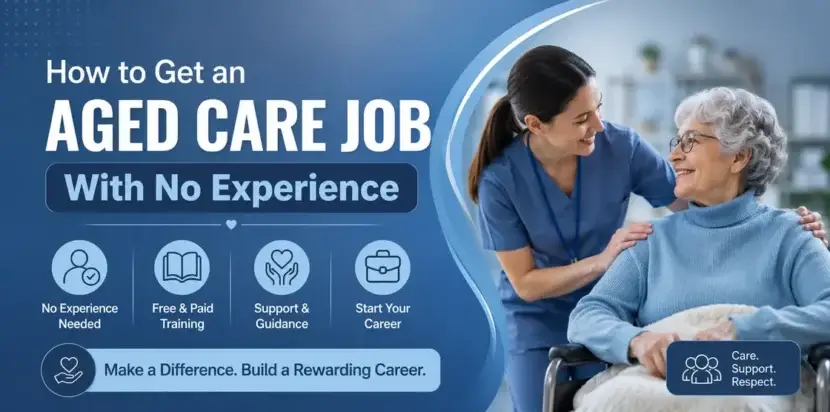
Getting an aged care job with no experience is easier than many people think. Most Australian aged care employers hire entry-level candidates who have the right qualification, a genuine interest in supporting older people, and the willingness to learn. Previous paid experience is helpful, but it is not the deciding factor for many entry-level positions.
The best way to start is by completing a Certificate III in Individual Support (Ageing & Disability), gaining practical work placement experience, and applying for beginner-friendly roles with residential aged care providers and home care organisations. Many graduates secure their first job shortly after finishing placement because employers value practical skills and a positive attitude over an extensive employment history.
Quick Answer
Yes, you can get an aged care job with no experience in Australia. The fastest pathway is to complete a recognised Certificate III in Individual Support (Ageing & Disability), successfully finish your practical placement, prepare a tailored resume and apply for entry-level positions with aged care providers. Many employers provide structured induction programs and on-the-job training for new employees.
Can You Get an Aged Care Job With No Experience?
Yes. You can get an aged care job with no experience if you complete the required training, demonstrate strong interpersonal skills, and apply for entry-level positions.
Many people assume they need years of healthcare experience before applying for an aged care role. In reality, Australian employers regularly hire graduates who have never worked in healthcare before.
Employers understand that every experienced aged care worker started somewhere. Instead of focusing only on previous employment, recruiters often assess whether an applicant can:
- Communicate respectfully with older Australians
- Demonstrate compassion and empathy
- Work safely within workplace procedures
- Learn quickly during induction
- Work well within a team
- Provide person-centred care
These qualities are difficult to teach and often matter more than previous employment in another industry.
For this reason, hospitality workers, retail staff, childcare educators, cleaners, customer service professionals and parents returning to the workforce successfully transition into aged care every year.
Why Employers Hire Beginners
One of the biggest misconceptions about aged care is that employers only recruit experienced workers.
That is rarely the case.
Most organisations have their own workplace policies, documentation systems and care procedures. Even experienced workers need induction and orientation before working independently.
As a result, many employers prefer candidates who already have recognised training and the right attitude rather than applicants with experience gained in a completely different care environment.
Employers commonly look for candidates who demonstrate:
- Genuine compassion for older people
- Strong communication skills
- Reliability and professionalism
- Respect for client dignity
- Safe work practices
- A willingness to accept feedback
- Commitment to ongoing learning
These qualities are often developed during study, work placement and volunteer experience.
Why Are There So Many Entry-Level Aged Care Jobs?
Australia’s aged care workforce is expected to continue expanding over the coming decade as demand for residential aged care and in-home support increases.
At the same time, workforce shortages across many parts of the country mean employers regularly recruit graduates and entry-level employees.
This demand is particularly strong across:
- Residential aged care
- Home care services
- Community aged care
- Dementia care
- Palliative care
- Respite care
- Rehabilitation support
- Lifestyle and wellbeing programs
Job opportunities exist across metropolitan and regional Australia, including Sydney, Melbourne, Brisbane, Perth, Adelaide, Canberra and many rural communities where workforce demand is often even higher.
Where Do Entry-Level Aged Care Workers Find Employment?
Graduates work in a variety of care settings depending on their interests and employer requirements.
Common workplaces include:
|
Workplace |
Typical Entry-Level Roles |
|
Residential aged care facilities |
Personal Care Assistant (PCA), Aged Care Worker |
|
Home care services |
Home Care Worker, Community Support Worker |
|
Community care organisations |
Support Worker |
|
Respite services |
Care Worker |
|
Dementia care programs |
Personal Care Assistant |
|
Palliative care services |
Support Worker |
|
Retirement villages |
Lifestyle Assistant |
Each workplace offers different experiences, allowing new workers to build confidence before progressing into more specialised roles.
Who Can Start an Aged Care Career?
You do not need a healthcare background to start working in aged care.
One of the strengths of Australia’s aged care sector is the diversity of its workforce. People enter the profession from many different industries because employers value transferable skills alongside recognised qualifications.
Aged care is suitable for:
- School leavers
- Career changers
- International students with eligible work rights
- Permanent residents
- New migrants
- Parents returning to work
- Mature-age job seekers
- Hospitality professionals
- Retail workers
- Customer service staff
- Disability support workers
- Community volunteers
Many employers consider previous life experience an advantage because aged care relies heavily on communication, patience and relationship-building.
Transferable Skills Employers Value
Even if you have never worked in healthcare, you may already have skills that employers are looking for.
For example:
|
Previous Industry |
Transferable Skills |
|
Hospitality |
Customer service, teamwork, time management |
|
Retail |
Communication, problem solving, conflict resolution |
|
Childcare |
Personal care, patience, empathy |
|
Cleaning |
Hygiene standards, infection prevention awareness |
|
Administration |
Documentation, organisation, attention to detail |
|
Disability Support |
Person-centred care, communication, manual handling |
When writing your resume, focus on these transferable skills rather than your lack of aged care experience.
Good to Know
Many graduates receive their first job offer from the organisation where they complete their practical placement.
Treat every placement day as part of your job interview by:
- Arriving on time
- Following workplace procedures
- Asking thoughtful questions
- Showing initiative
- Building positive relationships with supervisors
- Demonstrating empathy and professionalism
A strong placement report often becomes your first professional reference.
What Qualifications Do You Need Before Applying?
Most employers expect applicants to hold, or be actively completing, a Certificate III in Individual Support (Ageing & Disability).
While a small number of employers recruit assistants without formal qualifications, completing recognised training significantly improves employability and prepares you to provide safe, high-quality care.
Before applying, employers commonly expect candidates to have several requirements in place.
1. Certificate III in Individual Support (Ageing & Disability)
The Certificate III in Individual Support (Ageing & Disability) is the most recognised entry-level qualification for people starting an aged care career in Australia.
The course teaches practical skills needed to work confidently in residential aged care, home care services, and community care.
Students typically learn how to:
- Deliver person-centred care
- Assist with personal care
- Support independence
- Apply infection prevention procedures
- Follow the Aged Care Quality Standards
- Communicate professionally
- Respond to individual support needs
- Assist people living with dementia
- Maintain workplace health and safety
- Record care documentation accurately
Work placement provides supervised practical experience in a real care environment, allowing students to apply classroom learning while building confidence.
2. National Police Check
Most employers require a current National Police Check before employment begins.
The check helps organisations meet compliance requirements and protect vulnerable older Australians.
3. NDIS Worker Screening Check
Some employers require a National Disability Insurance Scheme (NDIS) Worker Screening Check, particularly when positions involve disability support alongside aged care services.
Requirements vary between employers and states.
4. First Aid and CPR Certification
Many employers prefer applicants who hold current:
These qualifications demonstrate that candidates can respond appropriately during medical emergencies.
5. Vaccination Requirements
Some aged care providers require employees to meet workplace vaccination policies to help protect older people who are at higher risk of illness.
Requirements differ between employers and state or territory regulations.
Qualification Checklist Before Applying
Use this checklist before submitting your first application.
|
Requirement |
Recommended |
Commonly Required |
|
Certificate III in Individual Support (Ageing & Disability) |
✅ |
✅ |
|
Practical Work Placement |
✅ |
✅ |
|
National Police Check |
✅ |
✅ |
|
NDIS Worker Screening Check |
✅ |
Employer dependent |
|
First Aid Certificate |
✅ |
Frequently |
|
CPR Certificate |
✅ |
Frequently |
|
Resume |
✅ |
✅ |
|
Cover Letter |
✅ |
Recommended |
Completing most of these requirements before applying gives employers confidence that you can begin work with minimal delay.
Can I Apply for Aged Care Jobs While Studying?
Yes. Many aged care employers accept applications from students who are currently completing a Certificate III in Individual Support (Ageing & Disability), particularly if they have already started or completed their practical work placement.
If you’re studying, mention your expected completion date on your resume and highlight any placement experience you’ve gained. Employers often value motivated students who already understand workplace expectations and are ready to transition into paid employment after completing their qualification.
8 Steps to Get an Aged Care Job With No Experience
Step 1: Complete a Recognised Qualification
The fastest way to get an aged care job with no experience is to complete a recognised Certificate III in Individual Support (Ageing & Disability).
Employers prefer applicants who already understand:
- Safe manual handling
- Personal care techniques
- Infection prevention
- Communication skills
- Patient safety
- Professional boundaries
- Care planning
- Documentation requirements
Completing recognised training reduces onboarding time and shows employers that you are committed to working in the industry.
Step 2: Treat Your Work Placement as Your First Job
Many students underestimate the value of practical placement.
Employers do not.
Work placement gives you genuine workplace experience in an aged care facility under supervision.
During placement:
- Arrive early.
- Volunteer for appropriate tasks.
- Ask questions.
- Follow workplace procedures.
- Build relationships with supervisors.
- Demonstrate empathy in caregiving.
- Show professionalism every day.
Placement supervisors often recommend high-performing students to hiring managers before vacancies are advertised. Students who arrive early, communicate well and work confidently with residents frequently receive interview invitations before finishing their course.
Step 3: Build Experience Outside Paid Employment
Paid employment is only one form of experience.
Employers often value volunteer work that demonstrates compassion, responsibility, and commitment to supporting older people.
Examples include:
- Volunteer aged care experience
- Community support programs
- Local council wellbeing programs
- Hospital volunteer services
- Social support activities
- Meals on Wheels
- A palliative care volunteer pathway
- Weekend companionship programs
Volunteer work helps strengthen your resume while developing communication skills and confidence working with older Australians.
Step 4: Prepare an Aged Care Resume That Matches the Job
A tailored resume gives employers a clear reason to interview you, even if you have no previous aged care experience.
Recruiters often spend less than a minute reviewing each application. A clear, relevant resume makes it easier for employers to see your potential.
Focus on what you can offer instead of apologising for having no experience.
Include:
- Certificate III in Individual Support (Ageing & Disability)
- Work placement experience
- Volunteer experience
- First Aid and CPR certification
- National Police Check
- NDIS Worker Screening Check (if applicable)
- Communication skills
- Customer service experience
- Teamwork and reliability
- Availability for shift work
If you have worked in hospitality, retail, childcare or customer service, highlight transferable skills such as communication, problem-solving, teamwork and time management.
Resume Tips for Beginners
- Tailor your resume for every application.
- Use keywords from the job advertisement.
- Keep the resume to two pages.
- Include measurable achievements where possible.
- Proofread before submitting.
Want to improve your chances of getting an interview? Explore our Aged Care Resume Guide for resume templates, writing tips and examples designed specifically for entry-level aged care jobs.
Step 5: Write a Personalised Cover Letter
A personalised cover letter explains why you want to work in aged care and why you are a suitable candidate despite having no paid experience.
Avoid sending the same cover letter to every employer.
Instead, explain:
- Why you chose aged care
- What motivated your career change
- What you learned during training
- What you learned during placement
- Which personal strengths suit the role
- Why you want to work for that organisation
Employers often value genuine motivation more than previous experience.
Keep your cover letter concise, professional and focused on the employer’s needs.
Step 6: Apply for Entry-Level Aged Care Jobs
Start with roles designed for beginners.
Many aged care providers recruit graduates and entry-level workers throughout the year.
Common entry-level positions include:
|
Job Role |
Suitable for Beginners |
|
Personal Care Assistant (PCA) |
✅ Yes |
|
Aged Care Worker |
✅ Yes |
|
Home Care Worker |
✅ Yes |
|
Community Support Worker |
✅ Yes |
|
Residential Care Worker |
✅ Yes |
|
Lifestyle Assistant |
✅ Yes |
|
Support Worker |
✅ Yes |
Some employers offer structured graduate programs or mentoring for new staff.
Apply broadly rather than waiting for the “perfect” job.
Submitting applications to multiple employers increases your chances of receiving interviews.
Step 7: Prepare for Your Interview
Employers want to know whether you can provide safe, respectful and compassionate care.
Interview questions usually focus on your attitude, communication skills and understanding of person-centred care rather than technical expertise.
Expect questions such as:
- Why do you want to work in aged care?
- Tell us about yourself.
- How would you support someone living with dementia?
- Describe a time you helped another person.
- How do you manage challenging situations?
- Can you work weekends and public holidays?
- How do you maintain patient safety?
- How would you respond if a resident refused care?
Use examples from:
-
- Work placement
- Volunteer experience
- Previous employment
- Education
- Community activities
If you’re preparing for your first interview, our Aged Care Interview Questions and Answers Guide covers the most common questions employers ask, along with example answers and interview tips to help you make a strong impression.
If you don’t receive interviews after several applications, ask your trainer or placement supervisor to review your resume. Small improvements to your application can significantly increase your chances of being shortlisted.
Step 8: Follow Up and Keep Applying
Finding your first job often takes persistence.
If you do not receive an interview immediately:
- Apply for several positions every week.
- Update your resume regularly.
- Continue volunteering if possible.
- Complete additional short courses.
- Follow up professionally after interviews.
- Build connections through placement supervisors.
Every application improves your interview skills and increases your visibility with employers.
Where Can You Find Entry-Level Aged Care Jobs?
Australia has thousands of entry-level aged care vacancies across metropolitan, regional and rural communities.
Popular places to search include:
Online Job Boards
- SEEK
- Indeed
- Jora
- Workforce Australia
Large Aged Care Providers
Many national organisations regularly recruit graduates, including:
- BaptistCare
- Bupa Aged Care
- Regis Aged Care
- Opal HealthCare
- Estia Health
Local Employers
Don’t overlook:
- Residential aged care facilities
- Home care providers
- Community care organisations
- Not-for-profit providers
- Regional health services
Many smaller employers advertise vacancies directly on their websites.
How Much Can You Earn as an Entry-Level Aged Care Worker?
Entry-level aged care workers in Australia typically earn around AUD $30–$38 per hour, depending on their employer, employment type and the shifts they work. For full-time employees, this can equate to an annual salary of approximately $60,000–$75,000, before overtime and penalty rates.
According to the Fair Work Ombudsman, minimum pay rates are set under the Aged Care Award and reviewed regularly by the Fair Work Commission.
Your earnings can vary based on:
- Whether you’re employed casually, part-time or full-time
- Weekend, evening and public holiday penalty rates
- Your employer and workplace agreement
- Your location across Australia
- Your qualifications and experience
As you gain experience or progress into senior care or specialised support roles, your earning potential can increase further.
Want a detailed breakdown? Explore our Highest Paying Aged Care Jobs in Australia (Salary Guide 2026) to learn about hourly pay rates, annual salaries, penalty rates and career progression opportunities across Australia.
What Hiring Managers Notice
Hiring managers often pay attention to:
|
Hiring Managers Notice |
Why It Matters |
|
Punctuality |
Demonstrates reliability |
|
Communication |
Builds trust with residents |
|
Professionalism |
Shows workplace readiness |
|
Initiative |
Indicates willingness to learn |
|
Respect |
Reflects person-centred care |
During interviews, employers often look beyond technical knowledge. They want to see how you communicate, whether you can build rapport with older people, and if you understand the importance of dignity, respect and person-centred care.
Common Mistakes That Stop Beginners Getting Hired
Avoid these common mistakes when applying for your first aged care job.
👉 Applying before completing practical placement
Placement provides valuable workplace experience that employers recognise.
👉 Using the same resume for every employer
Tailor every application to the advertised position.
👉 Ignoring transferable skills
Customer service, teamwork and communication are highly valued in aged care.
👉 Applying to only one employer
Increase your opportunities by applying to multiple organisations.
👉 Arriving unprepared for interviews
Research the employer and practise answering common interview questions beforehand.
👉 Giving up too early
Many graduates receive job offers after several applications. Consistency matters.
Ready to Start Your Aged Care Career?
Gain the practical skills and confidence to apply for entry-level aged care jobs with our CHC33021 Certificate III in Individual Support (Ageing & Disability) course.
- Nationally recognised qualification
- Practical work placement
- Industry-ready skills
Comments are closed