
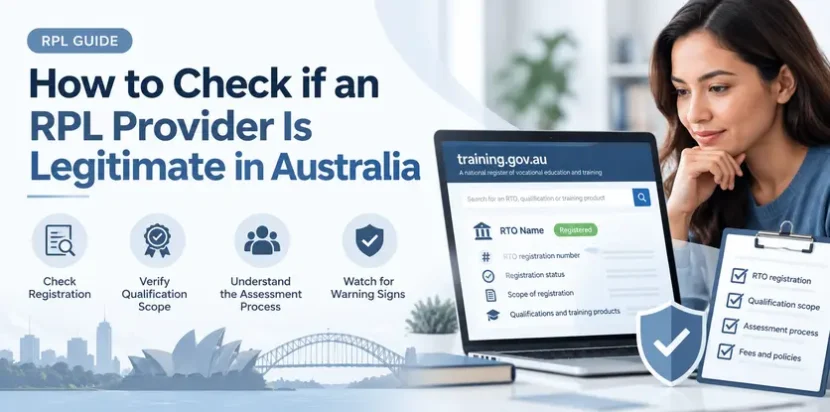
Choosing the right provider is an important step when applying for Recognition of Prior Learning (RPL) in Australia. Before paying fees or submitting your documents, you should verify the Registered Training Organisation (RTO) responsible for assessing your skills and issuing your qualification.
An RPL provider and a Registered Training Organisation (RTO) are not necessarily the same organisation. An RPL consultant may help you understand your options, but that does not automatically make the consultant an RTO. You need to know which organisation will assess your evidence, whether it is authorised to issue your intended qualification and what the assessment process involves.
This guide explains how to verify an RTO, check its qualification scope, identify potential warning signs and make an informed decision before applying for RPL.
Quick Answer: How Do You Verify an RTO Before Applying for RPL?
To verify an RTO in Australia, search for the organisation on training.gov.au, the National Register of Vocational Education and Training. Check its registration details, confirm that your exact qualification is within its approved scope, and contact the RTO to establish whether it currently offers the relevant RPL pathway. Before paying, also confirm who conducts the assessment, who issues the qualification, what evidence is required and what fees and conditions apply.
1. Check the RTO on the Official National Register
The first step is to verify the organisation independently rather than relying on an RTO number displayed on a website or advertisement.
Visit training.gov.au and search for the provider using its name or RTO registration number.
Check these details:
- Organisation name: Does the registered name match the provider you intend to use?
- RTO registration number: Does the number correspond to the correct organisation?
- Registration status: Is the organisation currently registered?
- Scope of registration: Is the qualification you need included in its approved scope?
- Contact details: Can you independently contact the registered organisation to clarify its services?
A provider’s website may display registration information, but you should verify that information against the official register.
Registration can change, so check the current record before applying rather than relying on an old advertisement, certificate or screenshot.
Official resource: National Register of VET — training.gov.au
2. Verify That the RTO Is Authorised to Issue Your Qualification
Finding a registered organisation is not enough. You must also check whether it is authorised to undertake the relevant assessment and issue the qualification you want.
An RTO’s scope of registration defines the nationally recognised training products it is approved to provide. Depending on its approved scope, an RTO may be authorised to deliver training and assessment or to undertake assessment and issue the relevant qualification.
For example, if you want a Certificate III qualification in Individual Support, do not rely solely on a provider’s general statement that it offers healthcare RPL.
Instead:
- Identify the exact qualification title and code.
- Find the qualification on the National Register of VET.
- Open the proposed RTO’s registration record.
- Review its scope of registration.
- Confirm that the qualification and relevant assessment or issuance activities are within its approved authority.
- Contact the RTO directly if anything is unclear.
Qualification codes and training products can change, so verify the current details instead of relying on old course information.
Does an RTO’s approved scope mean it currently offers RPL?
No. An approved scope establishes what the RTO is authorised to provide; it does not necessarily establish that the organisation currently offers the qualification or accepts RPL applications for it.
The National Register specifically advises individuals to contact the RTO to confirm delivery details.
Ask the provider:
- Is this qualification currently available through RPL?
- Are you accepting applications for this qualification?
- What assessment process applies?
- Are there any additional eligibility or assessment requirements?
- Which organisation will issue the qualification if I meet the requirements?
This extra step helps distinguish regulatory authority from actual service availability.
Official resource: training.gov.au — National Register of VET
3. Identify Who Will Assess Your RPL and Issue the Qualification
Some education consultants help applicants identify a suitable qualification, organise evidence or connect with an external RTO. Such arrangements mean that more than one organisation may be involved in the process.
The important thing is to understand each organisation’s responsibilities.
Before proceeding, ask:
- What is the full name of the RTO responsible for my assessment?
- What is its registration number?
- Who will review my evidence and determine whether I am competent?
- Which organisation will issue my qualification?
- Who will communicate the assessment outcome?
- Who should I contact if I have questions, a complaint or concerns about an assessment decision?
Verify the named RTO independently on the official register. If a consultant says that a partner RTO will issue your qualification, contact that RTO through its independently verified contact details to confirm the arrangement.
Be particularly careful if you cannot identify the actual RTO or if the organisations involved give conflicting explanations about who is responsible for your assessment.
What if an RPL consultant arranges everything for you?
You can use a consultant to help navigate the process, but you should still understand who is responsible for the formal assessment and qualification issuance.
Ask for the proposed RTO’s details in writing before making a payment. You should be able to independently confirm the provider’s identity, approved scope and role in the arrangement.
A consultant’s recommendation is not a substitute for verifying the RTO.
4. Understand What a Proper RPL Assessment Involves
Recognition of Prior Learning is an assessment process that evaluates skills and knowledge gained through previous work, training or relevant life experience against the requirements of a qualification or units of competency.
It is not an automatic entitlement to a qualification.
A suitable assessment process should explain what evidence is required, how that evidence will be evaluated and what happens if it does not demonstrate all the required competencies.
Depending on the qualification and your circumstances, evidence may include:
- Employment history and position descriptions.
- Statements of service or employer references.
- Work samples or a professional portfolio.
- Existing qualifications, certificates and training records.
- Relevant workplace records.
- Responses to assessment questions or professional discussions.
- Practical demonstrations or additional assessment activities, where required.
Not every applicant will need the same documents or assessment activities.
For example, someone with experience in individual support may have relevant employment records and workplace experience. These can help demonstrate competency, but the assessor must still determine whether the evidence meets the requirements of the relevant units of competency.
Read also: how to choose the right RTO for a healthcare course
What should a quality RPL process look like?
According to the Australian Skills Quality Authority (ASQA), an appropriate RPL process should be clear, fair, flexible, valid and reliable.
In practical terms, you should expect:
- Clear information about the assessment process before proceeding.
- Consideration of your individual circumstances.
- Appropriate ways to present relevant evidence.
- Assessment decisions based on the requirements of the qualification.
- An explanation of any competency gaps and possible next steps.
If your evidence is insufficient, further evidence, assessment or training may be needed. Ask the RTO to explain how this would work and whether additional costs may apply.
Official resource: ASQA — Credit transfer and recognition of prior learning
5. Look for Warning Signs Before Paying for RPL
RPL can be a legitimate way to have existing skills recognised. However, misleading promises and inadequate assessment practices are recognised risks in Australia’s vocational education and training sector.
ASQA has specifically highlighted concerns about unethical RPL marketing, inadequate assessment and qualifications issued without the required competency being demonstrated.
Treat the following claims as reasons to investigate further.
|
Warning sign |
What you should do |
|
Guaranteed qualification before assessment |
Ask how competency will be assessed and what determines the outcome. |
|
No evidence required under any circumstances |
Request a clear explanation of how your competency will be established. |
|
A certificate promised simply for paying a fee |
Do not rely on the promise; verify the RTO and its assessment process. |
|
Unclear identity of the issuing RTO |
Request the registered name and number in writing. |
|
The provider claims to offer every qualification |
Verify each specific qualification against the approved scope. |
|
No written explanation of fees or assessment requirements |
Request the terms before paying. |
|
Pressure to pay immediately without time to review documents |
Pause and verify the information independently. |
A short assessment timeframe or online process is not, by itself, proof of wrongdoing. The key questions are whether the assessment is appropriate, the evidence is sufficient and the outcome reflects demonstrated competency.
The safest approach is to verify the provider and understand the process before committing.
Official resource: ASQA — RPL and Credit Transfer Practice Guide
6. Review the Fees, Refund Policy and Enrolment Agreement
Before applying for RPL, obtain written information about the total cost and what the service includes.
Ask for clarification about:
- The total assessment fee.
- Any enrolment or administration charges.
- Additional costs for reassessment or further assessment activities.
- Whether further training may be required and what it might cost.
- Refund and cancellation conditions.
- Expected timeframes and factors that could delay the process.
- Which organisation receives payment and what each fee covers.
- Your rights, responsibilities and available complaints procedures.
Read the enrolment agreement before signing and keep copies of the documents you receive.
If you are dealing with both a consultant and an RTO, establish which organisation is responsible for each service and which terms govern your arrangement.
Do not compare providers on price alone. A lower advertised fee may not include the same services or assessment arrangements as another provider.
ASQA’s student guidance recommends checking pre-enrolment information, payment terms, refund policies and the responsibilities of any other organisation involved in training or assessment.
Official resource: ASQA — Choose a course and provider
7. Check Student Information, Complaints and Appeals
Before committing to an RPL pathway, make sure you understand where to find the RTO’s student information and how to raise concerns.
Look for clear information about:
- The qualification title and code.
- Assessment requirements and evidence.
- Fees and refund conditions.
- Student support and communication arrangements.
- Complaints and appeals procedures.
- The organisation responsible for assessment and certification.
You can also read independent reviews to learn about other customers’ experiences with communication, assessment support and fee transparency.
Reviews may help you identify questions to ask, but they do not prove that an RTO is currently registered or authorised to issue a particular qualification. Always verify those details using official sources.
What if you suspect misleading RPL practices?
Start by keeping relevant records, including advertisements, emails, agreements, payment receipts and messages about the promised service.
If you have a dispute, use the provider’s complaints process first. Depending on the nature of the issue and the provider’s regulatory arrangements, you may also seek guidance from the relevant regulator or the National Training Complaints Hotline.
ASQA explains that it can receive concerns about training providers but does not resolve individual student disputes.
Official resource: ASQA — Concerns about training providers
RTO Verification Checklist Before Applying for RPL
Before submitting your application or making a payment, work through this checklist.
- I have searched for the provider on training.gov.au.
- I have checked the organisation’s identity and current registration status.
- I have verified the exact qualification title and code.
- I have checked the RTO’s approved scope for the relevant assessment and issuance activities.
- I have confirmed that the RTO currently offers the RPL pathway I need.
- I know which organisation assesses my evidence.
- I know which organisation will issue the qualification.
- I understand the assessment process and evidence requirements.
- I have received written information about fees and additional costs.
- I have reviewed the refund, cancellation and enrolment terms.
- I understand that RPL approval depends on an assessment of competency.
- I know how to contact the RTO independently and where to raise concerns.
If you cannot confirm one of the critical details, resolve it before proceeding.
Verify First, Then Choose Your RPL Pathway
Choosing an RTO for Recognition of Prior Learning requires more than comparing fees or looking for the fastest advertised service.
Check the provider’s registration, confirm the relevant qualification is within its approved scope, establish whether the pathway is currently available and understand who will assess your evidence and issue the qualification.
These checks help you make an informed decision before committing money or personal documents.
Already have relevant work experience? Care Connect Training Institute helps people explore suitable training and RPL pathways through external training providers.
You can start by exploring the available RPL qualification pathways and asking for the details of the proposed RTO. Verify the organisation independently before proceeding with an application.
Your experience may provide a foundation for RPL. A proper assessment determines whether it meets the required competencies.
Ready to Explore Your RPL Pathway?
Your experience could count towards a nationally recognised qualification. Check your eligibility and discover your next step with Care Connect Training Institute.
Check Your RPL Eligibility →Find answers to common questions about our RPL
Frequently Asked Questions
Check the provider's approved scope of registration on the National Register of VET. Confirm that the exact qualification and relevant assessment or issuance activities are within its approved authority. Contact the RTO to verify that it currently offers the relevant pathway.
A consultant may help applicants navigate an RPL pathway through an external provider. However, you should independently verify the RTO responsible for assessment and qualification issuance, and establish each organisation's responsibilities before paying.
RPL requires an assessment of existing skills and knowledge against the relevant competency requirements. The type and amount of evidence or assessment activity will depend on the qualification and your circumstances. Experience alone does not guarantee approval.
No. A short timeframe alone does not establish that a provider is acting improperly. However, guaranteed outcomes without appropriate assessment, unclear evidence requirements and pressure to pay without adequate information warrant further investigation.
Start with the provider's complaints process and keep records of your interactions. You can also consult ASQA's guidance on concerns about training providers to understand the available reporting options and which organisation may be responsible for handling your concern.


Comments are closed