
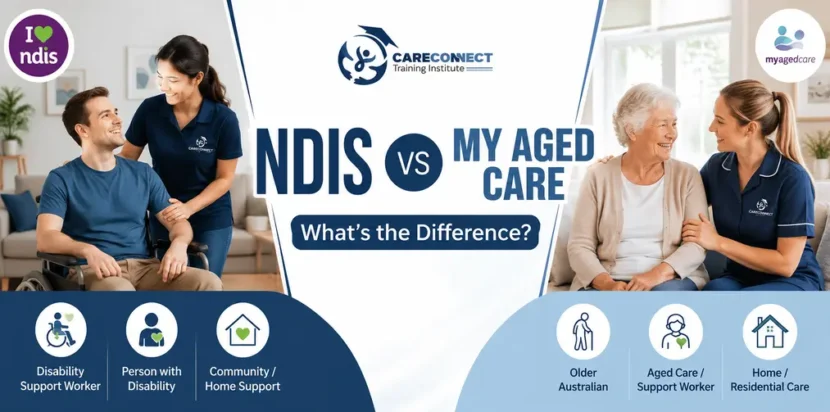
If you work in care—or are thinking about becoming a support worker—you will likely come across both the National Disability Insurance Scheme (NDIS) and My Aged Care.
They are both important parts of Australia’s care system, but they are not the same programme.
The NDIS is primarily designed to support eligible people with permanent and significant disability, while My Aged Care is the main entry point for eligible people seeking government-funded aged care services.
Understanding the difference can help you better understand the people you support, the services they may access and the type of care career you want to pursue.
NDIS vs My Aged Care
The NDIS and My Aged Care are separate Australian Government systems with different purposes. The NDIS supports eligible people with permanent and significant disability, while My Aged Care connects eligible people with government-funded aged care services based on their age, care needs and circumstances.
Their eligibility rules, assessment processes and support arrangements are different.
What Is the NDIS?
The National Disability Insurance Scheme (NDIS) is Australia’s national disability support scheme.
It provides funding for eligible people with permanent and significant disability to access reasonable and necessary disability-related supports.
A person generally needs to meet the NDIS eligibility requirements relating to factors such as age, residency and disability.
For people applying to become NDIS participants, the age requirement generally means being under 65 on the day they apply. People who become NDIS participants before turning 65 may be able to remain on the NDIS after turning 65, depending on their circumstances.
NDIS supports can be connected to a person’s disability, needs and goals. Depending on the person’s circumstances and plan, this may involve support with areas such as:
-
- Daily activities
-
- Independence
-
- Community participation
-
- Assistive technology
-
- Home and living arrangements
-
- Disability-related capacity building
-
- Other eligible disability-related supports
The NDIS does not automatically cover every service a person might need. Funding and support depend on the participant’s individual circumstances and NDIS plan.
What Is My Aged Care?
My Aged Care is Australia’s main entry point for accessing government-funded aged care services.
It helps eligible people find and access aged care based on their age, care needs and circumstances.
Government-funded aged care can support people with needs such as assistance with everyday activities, personal care, clinical care, support at home and residential aged care. The services available depend on the person’s assessment and approved care arrangements.
For many people, accessing aged care begins with an assessment.
The assessment helps determine whether the person is eligible for government-funded aged care and what type of support may be appropriate.
NDIS vs My Aged Care: Key Differences
The easiest way to understand the difference is to look at who each system is designed to support and why they need assistance.
| Factor | NDIS | My Aged Care |
| Main purpose | Disability-related support | Aged care and support related to ageing |
| Primary focus | Eligible people with permanent and significant disability | Eligible people with assessed aged care needs |
| Typical age pathway | Generally under 65 when becoming a participant | Generally 65+, with specific exceptions |
| Access process | NDIS application and eligibility process | Aged care assessment |
| Support approach | Individual disability-related supports and goals | Services based on assessed aged care needs |
| Common settings | Home, community and supported living | Home, community and residential aged care |
| Funding arrangements | NDIS funds eligible supports according to a participant’s plan | Aged care funding operates through the aged care system |
The NDIS and aged care system are separate government systems and work differently.
What Is the Biggest Difference Between NDIS and My Aged Care?
The biggest difference is the reason for the person’s support needs.
The NDIS is focused on eligible people with permanent and significant disability.
My Aged Care is focused on eligible people who require aged care because of their care needs and circumstances.
That distinction is important because two people may need help with similar everyday activities but access different systems.
For example, a person with a permanent and significant disability may be eligible for the NDIS, while an older person who needs assistance with everyday activities because of ageing may access support through My Aged Care following an assessment.
Who Can Access the NDIS?
To become an NDIS participant, a person needs to meet the relevant eligibility requirements.
These include requirements relating to:
-
- Age
-
- Residency
-
- Disability
-
- The impact of the disability on everyday life
A person must generally be under 65 when they apply to become an NDIS participant. Meeting one requirement alone does not guarantee NDIS access.
For the most current eligibility information, readers should check the official NDIS requirements before applying.
Who Can Access My Aged Care?
Eligibility for government-funded aged care is based on a person’s age, care needs and circumstances.
Generally, a person must:
-
- Be aged 65 or over and have assessed care needs; or
-
- Meet one of the specific age exceptions under the aged care system.
For example, Aboriginal and Torres Strait Islander people may be eligible from age 50, and there are also provisions for people aged 50 and over who are homeless or at risk of homelessness.
The aged care system is generally not designed for people under 65, although specific circumstances and existing arrangements can apply.
How Does the NDIS Access Process Work?
If someone wants to become an NDIS participant, they need to go through the NDIS access process and demonstrate that they meet the relevant eligibility requirements.
The process is different from My Aged Care.
A simplified overview is:
-
- Check NDIS eligibility requirements.
-
- Apply to the NDIS if eligible to apply.
-
- Provide information and evidence relevant to the application.
-
- The NDIA assesses eligibility.
-
- If accepted, the person becomes an NDIS participant and can go through the planning process.
The exact process can depend on the person’s circumstances.
How Does My Aged Care Work?
My Aged Care generally starts with an assessment.
A simplified pathway is:
-
- Contact My Aged Care or apply for an assessment.
-
- Discuss the person’s care needs and circumstances.
-
- Complete an aged care assessment.
-
- Receive an assessment outcome.
-
- Access appropriate aged care services if eligible.
The assessment determines whether the person is eligible and which aged care programme or services may apply.
This is an important difference from the NDIS: the two systems have different access and assessment frameworks.
Can Someone Access Both NDIS and My Aged Care?
This is one of the areas where people should be particularly careful.
The NDIS states that a person cannot use NDIS and aged care supports at the same time. However, a person’s circumstances can change, particularly when an NDIS participant reaches older age or begins receiving aged care services.
For example, an NDIS participant who was already on the scheme before turning 65 can remain on the NDIS after turning 65.
However, current NDIS guidance states that a participant must leave the NDIS if they permanently move into residential aged care after turning 65 or start receiving permanent home care services through the aged care system after turning 65.
Because transition rules can depend on individual circumstances, people should check their situation directly with the NDIS or My Aged Care rather than assuming that one pathway automatically applies.
What Happens When an NDIS Participant Turns 65?
Turning 65 does not automatically mean that an existing NDIS participant must leave the NDIS.
If a person became an NDIS participant before their 65th birthday, they can remain on the NDIS after turning 65.
However, there are specific circumstances in which they will need to leave the NDIS and transition to aged care. For example, current NDIS guidance says a participant will leave the NDIS if they permanently move into residential aged care after turning 65 or begin receiving permanent home care services through the aged care system.
This is why transition planning can be important for participants approaching or passing this stage of life.
What About Younger People and Aged Care?
Australia’s aged care system is generally not designed for younger people under 65.
The NDIS has a specific role in supporting eligible younger people with permanent disability to live in the community and access appropriate disability-related supports.
The NDIS also has a commitment to reducing the number of younger people living in residential aged care, except in exceptional circumstances or where the person chooses to remain there.
This distinction is particularly relevant for disability support workers because some younger people may need support to explore more age-appropriate home and living arrangements.
NDIS Support Worker vs Aged Care Worker
The difference between NDIS and My Aged Care is also important if you are considering a career in the care sector.
An NDIS support worker may support people with disability with activities such as daily living, community participation, independence and other disability-related goals, depending on the role and participant.
An aged care worker may support older Australians with personal care, everyday activities, social participation and other care needs, depending on their role and workplace.
There can be significant overlap in practical skills.
Both roles can involve:
-
- Person-centred support
-
- Communication
-
- Active listening
-
- Personal care
-
- Supporting independence
-
- Maintaining dignity and privacy
-
- Professional boundaries
-
- Documentation
-
- Working with families and care teams
But the people being supported, care environment, responsibilities and employer expectations can differ.
What Does NDIS vs My Aged Care Mean for Support Workers?
Understanding the difference is useful because support workers do not work with a single type of client or funding arrangement.
A disability support worker may work with people whose supports are connected to the NDIS.
An aged care worker may work with older people receiving services through Australia’s aged care system.
The worker’s responsibilities will depend on the specific role, employer, participant or client and service environment.
For a support worker, this means that understanding the broader care system can complement practical skills.
However, knowing how NDIS or aged care funding works does not replace the need to understand:
-
- Person-centred care
-
- Duty of care
-
- Professional boundaries
-
- Communication
-
- Documentation
-
- Privacy
-
- Safe work practices
-
- Individual needs and preferences
The goal is not simply to understand which government system funds support. It is to understand how to provide safe, respectful and person-centred support within your role.
Do NDIS Support Workers and Aged Care Workers Need the Same Qualification?
Not necessarily.
There is no single qualification that automatically applies to every support worker or aged care position.
The appropriate training can depend on:
-
- The job
-
- The employer
-
- The service environment
-
- The responsibilities of the role
-
- Industry expectations
-
- Applicable requirements
Relevant qualifications can include:
CHC33021 Certificate III in Individual Support
This qualification can be relevant to people pursuing careers across areas of individual support, depending on the qualification’s specialisation, role and employer requirements.
CHC43121 Certificate IV in Disability Support
This qualification is relevant to disability support training and can be considered by people pursuing disability-focused career pathways.
CHC43015 Certificate IV in Ageing Support
This qualification is focused on ageing support and can be relevant to people pursuing careers supporting older Australians.
Before choosing a course, it is important to look beyond the qualification title and consider the type of work you want to do.
Which Training Pathway Should You Choose?
Your preferred career direction is a useful starting point.
If You Want to Work in Disability Support
You may want to explore training that focuses on disability support, person-centred practice, independence and supporting people with disability.
A qualification such as CHC43121 Certificate IV in Disability Support may be relevant depending on your career goals and the roles you are considering.
If You Want to Work in Aged Care
You may want to explore training focused on ageing support, personal care, wellbeing and supporting older Australians.
CHC43015 Certificate IV in Ageing Support is one qualification relevant to this area.
If You Want a Broader Individual Support Pathway
If you are considering a broader entry pathway into the care sector, CHC33021 Certificate III in Individual Support may be worth exploring, depending on the career direction and role you are targeting.
The best choice depends on your circumstances and career goals rather than simply choosing the system that sounds more familiar.
What Skills Are Useful in Both NDIS and Aged Care?
Although the systems are different, many core support-work skills can be useful across both sectors.
Person-Centred Care
Support should focus on the individual, including their preferences, goals, needs, rights and choices.
Communication
Support workers need to communicate clearly with the person they support and, where appropriate, families, colleagues and other professionals.
Professional Boundaries
Workers need to understand their role and maintain appropriate professional relationships.
Documentation
Accurate documentation can be an important part of support work, although the exact documentation requirements depend on the workplace and role.
Respect and Dignity
People receiving support should be treated with dignity, respect and consideration.
Supporting Independence
A strong support approach is not simply about doing everything for someone. Depending on the person’s needs and goals, support can involve helping them participate, make choices and build independence.
NDIS vs My Aged Care: Which One Is Better?
Neither system is simply “better”.
They exist for different purposes.
The NDIS is primarily focused on eligible people with permanent and significant disability.
My Aged Care is the entry point for eligible people seeking government-funded aged care services.
The relevant system depends on the person’s circumstances, eligibility and care needs.
For support workers, the more useful question is:
What type of support does this person need, and what role am I responsible for providing?
Understanding the funding system is helpful, but person-centred support remains at the centre of good care practice.
Why This Difference Matters When Choosing a Care Career
If you are planning a career in Australia’s care sector, understanding the difference between disability support and aged care can help you make a more informed training decision.
Think about the people you would prefer to support.
Disability support may appeal to you if you are interested in:
-
- Supporting people with disability
-
- Promoting independence
-
- Community participation
-
- Individual goals
-
- Disability-focused services
Aged care may appeal to you if you are interested in:
-
- Supporting older Australians
-
- Personal care
-
- Home-based support
-
- Residential aged care
-
- Daily living assistance
-
- Supporting wellbeing and independence
There is also overlap between the sectors, particularly around individual support, communication and person-centred care.
What If You Already Have Care Experience?
If you have existing workplace experience, you may want to investigate Recognition of Prior Learning (RPL).
RPL is an assessment process that considers whether your existing skills, knowledge and experience demonstrate the competencies required for a qualification.
Importantly, having experience does not automatically mean you will receive a qualification.
You still need to complete the relevant assessment process and provide appropriate evidence of your competency.
If you are considering RPL, check the requirements of the specific qualification and training provider before making a decision.
Final Takeaway
NDIS and My Aged Care are two different systems serving different purposes.
The NDIS is primarily designed for eligible people with permanent and significant disability, while My Aged Care is the main entry point to Australia’s government-funded aged care system.
For support workers, understanding the distinction can make it easier to understand the environment in which they work and the people they support.
If you are choosing a career pathway, start by deciding who you want to support and what type of care work interests you. From there, compare the relevant qualifications, role requirements and training options.
If you already have relevant experience, RPL may also be worth exploring as an assessment pathway for recognising existing skills and knowledge.
Information Sources
This article was reviewed against current information published by:
Government requirements and aged care arrangements can change. Always check the relevant official source for the most current information before making decisions about eligibility, services or transitions.
Turn Your Existing Skills Into a Recognised Qualification
Already working in individual support, disability support or aged care? Explore Recognition of Prior Learning (RPL) and find out how your existing skills and experience may be assessed towards a recognised qualification.
Explore RPL PathwaysFind the Right Care Training Pathway for You
Explore Care Connect Training Institute’s training pathways for individual support, disability support and ageing support, and choose a course that aligns with your career goals.
Explore Our CoursesFind answers to common questions
Frequently Asked Questions
No. The NDIS and My Aged Care are separate Australian Government systems. The NDIS supports eligible people with permanent and significant disability, while My Aged Care provides access to government-funded aged care services for eligible people.
The NDIS is primarily focused on eligible people with permanent and significant disability, while My Aged Care is focused on aged care for people who meet the relevant age, care-needs and other eligibility requirements.
People generally need to be under 65 when applying to become an NDIS participant. However, someone who became an NDIS participant before turning 65 can remain on the NDIS after turning 65, subject to the relevant rules and circumstances.
Current NDIS guidance states that people cannot use NDIS and aged care supports at the same time. Transition arrangements can depend on the person's circumstances, so individuals should check their situation with the relevant government service.
Australia's aged care system is generally not designed for people under 65. However, specific eligibility pathways and existing arrangements apply to some people, including Aboriginal and Torres Strait Islander people aged 50 and over and people aged 50 and over who are homeless or at risk of homelessness.
No. There can be overlap in skills and responsibilities, but the people supported, service settings, duties and employer requirements can differ.
There is no single qualification that automatically applies to every NDIS support role. Requirements can vary by employer, role and service environment. Relevant training may help demonstrate skills and knowledge, but workers should check the requirements of the specific position.
There is no single best qualification for everyone. Your preferred career direction should guide your choice. Disability-focused training may suit someone interested in disability support, while ageing-support training may suit someone interested in aged care. Individual Support qualifications may also be relevant to broader care pathways.


Comments are closed