
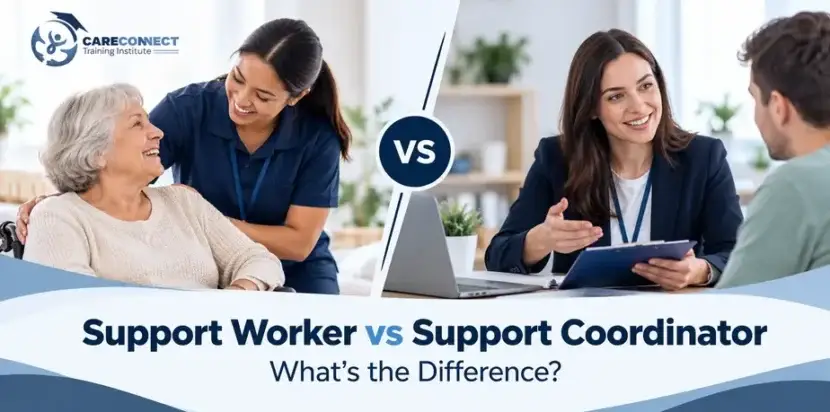
If you’re exploring a career in disability support or community services in Australia, you may have come across two roles that sound similar: support worker and support coordinator.
They are different roles with different responsibilities.
A support worker generally provides direct, practical support to a person with disability, while a support coordinator helps an NDIS participant understand and use their plan, connect with providers and services, and build their confidence and skills to manage their supports.
The distinction becomes much clearer when you look at what each professional does during a typical working day.
This guide compares support workers and support coordinators in Australia, including their responsibilities, skills, work environments, NDIS involvement, qualifications and potential career pathways.
What Is the Difference Between a Support Worker and Support Coordinator?
A support worker provides direct support to a person in their daily life, while a support coordinator focuses on helping an NDIS participant organise and use their supports. Support workers may assist with personal care, household tasks, daily activities and community participation. Support coordinators help participants understand their plans, connect with providers and services, and build their capacity to manage their supports.
The simplest way to remember the difference is:
Support Worker → provides direct support
Support Coordinator → helps coordinate and manage supports
Both roles can involve working closely with participants, but the purpose and nature of that work are different.
Support Worker vs Support Coordinator: At a Glance
|
Factor |
Support Worker |
Support Coordinator |
|
Main focus |
Direct support |
Coordination of supports |
|
Participant contact |
Direct, practical support |
Direct communication plus coordination |
|
Typical work |
Daily activities, personal care, household support and community participation |
Plan implementation, provider connections, service coordination and capacity building |
|
Hands-on work |
Generally more hands-on |
Generally less hands-on |
|
NDIS plan |
Provides supports based on the participant’s goals, needs and funded supports |
Helps the participant understand and use their plan |
|
Provider interaction |
May work for or alongside a provider |
Often communicates with multiple providers and services |
|
Documentation |
Records relevant support information |
Research, documentation, reporting and administration can be significant |
|
Key skills |
Communication, empathy, person-centred support and practical skills |
Communication, organisation, research, problem-solving and coordination |
|
Work style |
Direct participant-facing work |
Participant-facing, coordination and administrative work |
|
Career direction |
Individual support, disability support, aged care and community services |
Support coordination and broader community-services pathways |
The NDIS Commission describes support coordination as less hands-on than general support work and highlights research, documentation, reporting and administration as important parts of the role.
What Does a Support Worker Do?
A support worker works directly with people who need assistance to participate in everyday life and work towards their goals.
In an NDIS context, the support a person receives depends on their goals, needs and the supports included in their plan. Support workers can assist with areas such as:
- Household tasks
- Meal preparation
- Cleaning and other daily activities
- Personal care
- Shopping
- Transport
- Appointments
- Community participation
- Social activities
- Developing everyday skills and independence
For example, a support worker might help a participant prepare a meal, attend an appointment, go shopping or participate in a community activity.
The work is generally practical and participant-facing.
Depending on the job, support workers may work in people’s homes, community settings, residential environments and other disability or care services.
The exact responsibilities vary according to the participant’s needs, the support arrangement and the employer.
What Does a Support Coordinator Do?
A support coordinator helps an NDIS participant use their plan effectively.
The NDIS says support coordinators can help participants:
- Understand and use the supports in their plan
- Choose appropriate providers
- Connect with community and mainstream services
- Build confidence and skills to manage their supports
- Coordinate supports around their goals
For example, a participant may need help finding appropriate services and providers.
A support coordinator may help the participant understand their available supports, explore suitable options, communicate with providers and coordinate services.
The support coordinator is therefore more focused on coordination, service navigation and capacity building than on providing everyday personal care themselves.
How Do Their Day-to-Day Responsibilities Differ?
The easiest way to understand the difference is to look at the type of work each role involves.
A Support Worker’s Day
Depending on the position, a support worker might:
- Meet with a participant at home or in the community.
- Assist with daily activities.
- Provide personal care where this forms part of the support arrangement.
- Help with household tasks.
- Support community participation.
- Assist with transport or appointments.
- Help develop everyday skills.
- Record relevant information about the support provided.
The NDIS notes that support work can include household, personal care, daily activity and community support.
A Support Coordinator’s Day
A support coordinator may spend time:
- Meeting with participants.
- Discussing goals and support needs.
- Helping participants understand their NDIS plan.
- Researching available services and providers.
- Communicating with providers.
- Connecting participants with community and mainstream services.
- Coordinating different supports.
- Preparing documentation and progress reports.
- Helping participants build skills and confidence to manage their own supports.
The NDIS states that support coordinators help participants use their plans, connect with providers and services, and build confidence and skills to coordinate their own supports.
Is Support Coordination a Hands-On Role?
Support coordination is generally less hands-on than direct support work.
A support worker may spend much of their working time directly assisting a participant with daily activities or community participation.
A support coordinator is more likely to spend time on:
- Planning
- Communication
- Service research
- Provider coordination
- Documentation
- Reporting
- Administration
- Helping participants understand their support options
The NDIS Commission identifies research, documentation, reporting and administration as important aspects of support coordination.
That doesn’t mean support coordinators have less contact with participants. They may work closely with participants, but their role is generally focused on helping coordinate and manage supports, rather than delivering those supports directly.
Where Do Support Workers and Support Coordinators Work?
Their working environments can also be quite different.
Support workers may work in:
- People’s homes
- Community settings
- Residential care environments
- Disability services
- Supported living environments
- Other individual support settings
Support coordinators may work across:
- Participant meetings
- Provider communication
- Community services
- Mainstream services
- Service coordination
- Documentation and reporting
- Administrative activities
A support coordinator can therefore spend considerable time communicating with different organisations and service providers.
The NDIS describes support coordination as helping participants connect with NDIS providers as well as community and mainstream supports and services.
What Skills Do Support Workers Need?
Support work requires a combination of interpersonal and practical skills.
Useful capabilities can include:
- Communication
- Active listening
- Empathy
- Patience
- Respect
- Person-centred practice
- Professional boundaries
- Teamwork
- Reliability
- Practical problem-solving
- Supporting independence
Every participant can have different goals, preferences, needs and support arrangements.
For that reason, effective support work involves adapting the way support is provided to the individual rather than treating every participant in the same way.
What Skills Do Support Coordinators Need?
Support coordination involves a different mix of capabilities.
Important skills can include:
- Communication
- Organisation
- Research
- Problem-solving
- Relationship building
- Networking
- Documentation
- Report writing
- Service navigation
- Understanding NDIS processes
- Coordinating multiple supports
- Administrative skills
The NDIS Commission’s current support-coordination career guidance highlights capabilities including understanding participant needs, exploring options, research, communication, documentation, reporting and administration.
Support Worker vs Support Coordinator vs Plan Manager
These three roles are sometimes confused, but they have different functions.
|
Role |
Main function |
|
Support Worker |
Provides direct assistance and support |
|
Support Coordinator |
Helps coordinate supports and connect participants with providers and services |
|
Plan Manager |
Helps manage the financial and administrative side of an NDIS plan |
The NDIS specifically distinguishes support coordinators from plan managers: a plan manager helps keep track of funding, while a support coordinator helps with supports.
Understanding this distinction is particularly useful if you’re researching different career paths within the NDIS sector.
What Are the Three Levels of NDIS Support Coordination?
The NDIS currently identifies three levels of support coordination that can be funded in a participant’s plan.
Level 1: Support Connection
Support connection helps participants:
- Understand their plan
- Connect with community and mainstream supports
- Build their confidence to manage their plan
Level 2: Support Coordination
Support coordination helps participants build confidence and skills to direct their lives, including areas such as:
- Maintaining relationships
- Living more independently
- Participating in the community
Level 3: Specialist Support Coordination
Specialist support coordination is a higher level of support for participants with more complex situations.
It focuses on helping maintain consistent services when there are challenges within the participant’s support environment.
These three levels describe types of NDIS-funded support coordination. They are not levels of seniority for support workers.
What Qualifications Are Relevant to Support Work?
There isn’t one universal qualification that automatically applies to every support worker position in Australia.
Requirements can vary depending on the employer, role and service environment.
However, CHC33021 Certificate III in Individual Support is a current nationally recognised qualification on the National Training Register.
Training.gov.au describes CHC33021 as reflecting roles in community, home or residential care settings where workers provide person-centred support to people who may require support because of ageing, disability or another reason.
The qualification includes a range of units covering individualised support and related community-services skills. It can also be packaged with electives for Ageing, Disability, or Ageing and Disability specialisations.
Training.gov.au states that candidates must complete at least 120 hours of work as detailed in the assessment requirements of the units.
So, if you’re researching an entry pathway into individual support, CHC33021 is an important qualification to investigate.
Is Certificate IV in Disability Support Relevant?
CHC43121 Certificate IV in Disability Support is another current nationally recognised qualification.
Training.gov.au describes the qualification as preparing workers to provide disability support in community settings and people’s homes, with a focus on:
- Independence
- Self-reliance
- Community participation
- Wellbeing
- Person-centred support
- Individualised plans
The qualification also reflects roles where workers may supervise or coordinate a small team.
This makes CHC43121 relevant to people who want to develop their capabilities in disability support and take on broader responsibilities.
However, a qualification should not be presented as an automatic guarantee of employment in a particular role. Individual employers can have their own requirements.
Does a Support Coordinator Need a Specific Qualification?
There isn’t one universal qualification that applies to every support coordination position.
Requirements can depend on:
- The employer
- The specific position
- Participant needs
- The complexity of the role
- Relevant experience
- Training and professional development
The NDIS Commission’s current career guidance focuses on capabilities needed for support coordination, including understanding participant needs and options, research, communication, documentation, reporting and administration.
If you’re interested in support coordination, check the requirements of individual positions rather than assuming that one qualification applies to every employer.
Can a Support Worker Become a Support Coordinator?
Potentially, yes. But it isn’t an automatic promotion.
Experience in direct support can provide useful knowledge of participant needs, person-centred practice and disability-support environments.
However, support coordination involves additional responsibilities.
Someone moving towards support coordination may need to develop skills in:
- NDIS processes
- Service navigation
- Provider communication
- Research
- Documentation
- Report writing
- Coordination
- Problem-solving
- Administration
The NDIS Commission identifies general support work as a possible foundation for moving towards support coordination, while also highlighting the additional knowledge and capabilities involved in coordination work.
The transition is therefore better understood as a change in responsibilities and skill requirements, rather than simply moving to a higher job title.
Which Role Might Suit Your Career Goals?
There isn’t one role that suits everyone.
The type of work you enjoy is an important consideration.
Support work may suit you if you prefer:
- Direct participant interaction
- Practical assistance
- Daily activities
- Community participation
- One-to-one relationships
- Hands-on support
- Helping people develop everyday skills
Support coordination may interest you if you prefer:
- Planning
- Research
- Problem-solving
- Communication
- Service navigation
- Working with multiple providers
- Documentation
- Administration
- Coordinating supports
The difference is therefore less about one role being universally better and more about the type of work you want to perform.
Already Working in Support? RPL May Be Worth Exploring
If you already have relevant workplace experience, Recognition of Prior Learning (RPL) may be another pathway worth investigating.
RPL is an assessment process that considers existing skills, knowledge and experience against the requirements of a qualification.
Experience alone does not automatically result in a qualification. You may need to provide appropriate evidence for an assessor to determine whether your existing competency meets the relevant requirements.
Depending on the qualification and assessment process, evidence can include things such as:
- Employment records
- Workplace documents
- Certificates
- Work samples
- Supervisor evidence
- Other relevant evidence of skills and knowledge
Care Connect Training Institute’s supplied business information states that it supports RPL pathways through partner RTOs for qualifications including Certificate III in Individual Support, Certificate IV in Disability Support and Diploma of Community Services.
If you already have relevant experience, discussing your background and evidence with an appropriate training provider can help determine whether RPL is suitable.
A Possible Career Pathway
There isn’t one fixed career path through disability and community services.
One possible pathway could look like:
Relevant training or experience
↓
Support Worker
↓
Build disability/community-services experience
↓
Develop additional coordination and NDIS capabilities
↓
Explore Support Coordination opportunities
↓
Move into specialised coordination or other community-services roles, depending on experience and employer requirements
This is an example of a possible pathway, not a guaranteed progression route.
Support Worker vs Support Coordinator: Which Role Might Fit You?
|
If you prefer… |
You may want to explore… |
|
Direct participant support |
Support Worker |
|
Practical daily assistance |
Support Worker |
|
Personal care |
Support Worker |
|
Community participation |
Support Worker |
|
Hands-on work |
Support Worker |
|
Planning and coordination |
Support Coordinator |
|
Research and service navigation |
Support Coordinator |
|
Provider communication |
Support Coordinator |
|
Documentation and reporting |
Support Coordinator |
|
Coordinating multiple supports |
Support Coordinator |
This isn’t a ranking. The roles perform different functions within the broader disability-support system.
Final Takeaway
The difference between a support worker vs support coordinator mainly comes down to the type of support they provide.
A support worker generally provides direct, practical support with areas such as daily activities, personal care, household tasks, community participation and developing independence.
A support coordinator generally helps an NDIS participant understand and use their plan, connect with providers and services, coordinate supports and build the confidence and skills to manage those supports.
Neither role is simply a better version of the other. They involve different responsibilities, skills and working styles.
If you’re starting a career in individual or disability support, CHC33021 Certificate III in Individual Support is one relevant qualification to investigate. If you’re developing your disability-support capabilities, CHC43121 Certificate IV in Disability Support is another current qualification to consider, depending on your career direction and the requirements of the role you’re targeting.
If you already have relevant industry experience, RPL may also be worth exploring as an assessment pathway towards a relevant qualification.
Explore Your Support & Disability Training Pathway
Find a training pathway that matches your experience and career goals.
Explore Training Options →
Comments are closed