
Skip to content
  • [email protected]
  • +61 434 956 070
Care Connect Training Institute
?php echo get_bloginfo( 'name' ); ?>
  • Home
  • About Us
  • Courses
    • CHC43015 Certificate IV in Ageing Support
    • CHC33021 Certificate III in Individual Support
    • CHC43121 Certificate IV in Disability Support
    • Short Courses
      • HLTAID009 Provide Cardiopulmonary Resuscitation
      • HLTAID010 Provide Basic Emergency Life Support
  • RPL Qualifications
    • Health & Community
      • Certificate IV in Ageing Support RPL
      • Certificate III in Individual Support (age care & disability support)
      • Diploma of Community Services RPL
      • Certificate IV in Disability Support RPL
    • Childcare Industry
      • Certificate III in Early Childhood Education and Care RPL (CHC30121)
      • Diploma of Early Childhood Education and Care RPL (CHC50121)
    • Hospitality & Cookery
      • Certificate III in Commercial Cookery RPL (SIT30821)
      • Certificate IV in Kitchen Management RPL (SIT40521)
      • Diploma of Hospitality Management RPL (SIT50422)
      • Advanced Diploma of Hospitality Management RPL (SIT60322)
      • Certificate III in Baking RPL (FBP30521)
      • Certificate III in Patisserie RPL (SIT31021)
      • Certificate IV in Patisserie RPL (SIT40721)
      • Certificate III in Meat Processing (Retail Butcher) RPL (AMP30815)
    • Building & Construction
      • Certificate III in Carpentry RPL (CPC30220)
      • Certificate III in Bricklaying and Blocklaying RPL (CPC40920)
      • Certificate IV in Building and Construction RPL (CPC40120)
      • Diploma of Building and Construction RPL (CPC50220)
      • Certificate III in Painting and Decorating RPL (CPC30620)
    • Business & Management
      • Certificate III in Business RPL (BSB30120)
      • Certificate IV in Business RPL (BSB40120)
      • Diploma of Business RPL (BSB50120)
      • Certificate IV in Leadership and Management RPL (BSB40520)
      • Diploma of Leadership and Management RPL (BSB50420)
      • Graduate Diploma of Management (Learning) RPL -BSB80120
    • IT & Engineering
      • Advanced Diploma of Information Technology RPL (ICT60220)
      • Advanced Diploma of Civil Construction Design RPL (RII60520)
    • Automotive
      • Certificate III in Light Vehicle Mechanical Technology RPL (AUR30620)
      • Certificate IV in Automotive Mechanical Diagnosis RPL (AUR40216)
      • Diploma of Automotive Technology RPL (AUR50216)
      • Certificate III in Automotive Body Repair Technology RPL (AUR32120)
      • Certificate III in Heavy Commercial Vehicle Mechanical Technology RPL (AUR31120)
    • Beauty & Hair
      • Certificate II in Salon Assistant RPL (SHB20216)
      • Diploma of Salon Management RPL (SHB50216)
      • Certificate III in Hairdressing RPL (SHB30416)
      • Certificate IV in Hairdressing RPL (SHB40216)
      • Certificate IV in Beauty Therapy RPL (SHB40121)
      • Diploma of Beauty Therapy RPL (SHB50121)
      • Certificate III in Barbering RPL (SHB30516)
  • Blog
  • Contact
  • Enroll Now
Care Connect Training Institute

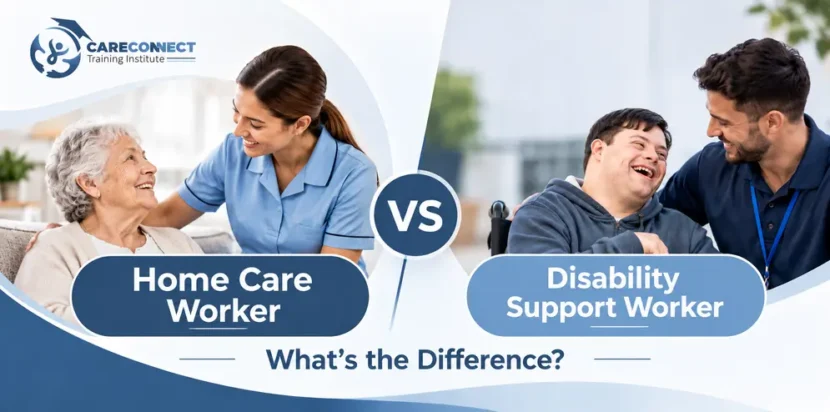
Home Care Worker vs Disability Support Worker: What’s the Difference?

  • Home
  • Blog
  • Home Care Worker vs Disability Support Worker: What’s the Difference?
Home Care Worker vs Disability Support Worker
  • September 25, 2026
  • Care Connect Training Institute
  • 10 Views

Home care workers and disability support workers both help people with everyday activities, independence and wellbeing, but they do not necessarily work with the same client groups or in the same service settings.

A home care worker commonly supports people in their own homes or communities, often within aged care and home-based support services. A disability support worker supports people with disability according to their individual needs, goals and support arrangements.

There is considerable overlap between the two roles. Personal care, meal preparation, household assistance and community participation can all be part of either role. The important differences are usually the person being supported, the purpose of the support, the service environment and the requirements of the specific job.

If you’re considering a career in Australia’s care sector, understanding these differences can help you investigate the right type of work and the most relevant training pathway.

QUICK ANSWER

Home Care Worker vs Disability Support Worker

Both roles support people with everyday activities and independence, but their client groups, responsibilities and service contexts can differ.

01
 

Home Care Worker


A home care worker generally provides support to people in their own homes or communities, often within aged care or other home-based services.

Depending on the position, duties may include personal care, household assistance, meal preparation, transport and support with everyday activities.

Common focusDaily living & independence

VS
02
 

Disability Support Worker


A disability support worker supports people with disability with daily living, independence, skill development and community participation.

The work may take place in a person’s home, in the community or in supported living environments.

Common focusGoals, skills & participation

The two roles can overlap significantly, so the job title alone does not tell you everything about the work. The client group, individual goals, service model and employer requirements also matter.

Home Care Worker vs Disability Support Worker: At a Glance

Factor

Home Care Worker

Disability Support Worker

Typical people supported

Often older people receiving home-based care

People with disability

Common settings

People’s homes and community settings

People’s homes, community and supported living settings

Main focus

Daily living, personal care, independence and wellbeing

Independence, daily living, skill development and participation

Personal care

May be part of the role

May be part of the role

Household assistance

May be part of the role

May be part of the role

Community participation

May be part of the role

Often an important part of support

Common service context

Aged care and home-based support

Disability services, including NDIS-related support

CHC33021

Relevant

Relevant

CHC43015

Relevant to specialised aged services

Not the primary disability qualification

CHC43121

Not the primary aged-care qualification

Specifically focused on disability support

Work style

Often one-to-one and home/community based

Can be one-to-one or involve supported living/community services

These are broad distinctions rather than fixed rules. Actual duties depend on the employer, position description, person’s needs and service being delivered.

What Does a Home Care Worker Do?

A home care worker provides practical support to a person in their own home or community.

For older people receiving government-funded aged care at home, the current Support at Home program is an important part of Australia’s aged care system. It provides coordinated care and services based on assessed ageing-related care needs and is designed to help older people remain at home for longer. Support at Home replaced the Home Care Packages Program and Short-Term Restorative Care Programme on 1 November 2025.

Common home care worker duties may include:

  • Assisting with personal care
  • Supporting dressing and grooming
  • Helping with mobility and daily routines
  • Preparing meals
  • Assisting with household tasks
  • Providing social support
  • Supporting community participation
  • Accompanying a client to appointments or activities
  • Helping a person maintain independence
  • Following an individualised care or support plan
  • Observing and reporting relevant changes
  • Maintaining required workplace documentation

Not every home care position includes all of these duties.

For example, one position might focus mainly on domestic assistance and social support, while another may involve more personal care.

Always check the actual position description rather than assuming every home care worker has the same responsibilities.

For a more detailed career pathway, see our guide to how to become a home care worker in Australia.

What Does a Disability Support Worker Do?

A disability support worker works with people with disability and provides support based on their individual needs, goals and support arrangements.

The NDIS describes support workers as people who can assist participants with everyday activities and help them develop skills and work towards their goals. The type of support depends on the person’s needs, goals and funded supports.

Common disability support worker duties may include:

  • Supporting personal care
  • Helping with daily routines
  • Preparing meals
  • Assisting with household tasks
  • Supporting development of everyday living skills
  • Helping people access the community
  • Supporting social participation
  • Accompanying people to appointments or activities
  • Supporting individual goals
  • Following individualised support plans
  • Recording relevant information
  • Supporting independence

The actual role can vary considerably.

One disability support worker might spend much of their time supporting community participation, while another might provide more intensive daily assistance in a supported living environment.

The current CHC43121 Certificate IV in Disability Support describes work in community settings and people’s homes, with a focus on supporting people with disability to achieve greater independence, self-reliance, community participation and wellbeing.

Where Do Home Care Workers and Disability Support Workers Work?

The work settings can overlap considerably.

Home Care Workers

Home care work may involve:

  • A client’s home
  • Community locations
  • Aged care home-based services
  • Other community-based support services

Support at Home is designed to help older people remain at home by providing services according to their assessed needs and goals.

Disability Support Workers

Disability support workers may work in:

  • People’s homes
  • Community settings
  • Supported living environments
  • Disability service organisations
  • Other community-based support settings

CHC43121 specifically reflects disability support work across community settings and people’s homes.

The important point

Neither role is defined only by location.

A home care worker and a disability support worker can both visit someone’s home and provide one-to-one assistance.

The bigger distinction is who the person is, why they receive support and what the worker is helping them achieve.

What Is the Main Difference Between Home Care and Disability Support?

The easiest way to understand the difference is to look at the purpose of the support.

Home Care

Home care is commonly focused on helping a person manage everyday life at home and maintain independence.

For example, a worker might help an older person:

  • Prepare meals
  • Complete personal care
  • Manage household activities
  • Attend an appointment
  • Stay connected with their community

Disability Support

Disability support focuses on supporting a person with disability according to their individual needs and goals.

For example, a worker might help someone:

  • Develop daily living skills
  • Prepare meals independently
  • Access the community
  • Attend social activities
  • Build confidence with everyday tasks
  • Participate in employment or other activities

There is significant overlap.

A person receiving disability support may need personal care and household assistance. An older person receiving home care may also need community participation and support to maintain independence.

So the difference is not simply the task being performed.

The context and purpose of the support matter.

What Skills Do You Need for These Roles?

Although the roles differ, many skills are transferable.

Skills Relevant to Both Roles

Support workers commonly need strong:

  • Communication skills
  • Active listening
  • Patience
  • Empathy
  • Reliability
  • Respect for privacy and dignity
  • Professional boundaries
  • Observation skills
  • Documentation skills
  • Person-centred practice
  • Ability to follow support or care plans
  • Ability to work safely and responsibly

These skills help workers build respectful relationships and provide support that reflects the person’s needs and preferences.

For a deeper look at the interpersonal skills used across aged care, disability support, home care and community services, see our guide to support worker soft skills.

Skills That May Be Particularly Useful in Home Care

Home care workers may need to be comfortable with:

  • Personal care
  • Household assistance
  • Supporting older people
  • Working independently in a client’s home
  • Mobility assistance
  • Meal preparation
  • Supporting daily routines
  • Maintaining dignity and privacy

The Support at Home framework is designed around assessed needs, goals and preferences, with a focus on helping older people remain at home.

Skills That May Be Particularly Useful in Disability Support

Disability support workers may need stronger emphasis on:

  • Supporting individual goals
  • Building independence
  • Skill development
  • Community participation
  • Person-centred practice
  • Supporting people with different communication needs
  • Following individualised plans
  • Working with people who may have complex support needs

CHC43121 includes units covering community participation and social inclusion, ongoing skills development, person-centred behaviour support and services for people with disability with complex needs.

Do Home Care Workers and Disability Support Workers Need the Same Qualification?

Not always.

There is no single qualification that automatically applies to every support worker position in Australia. Requirements can vary according to the employer, role, setting and responsibilities.

However, CHC33021 Certificate III in Individual Support is particularly relevant to people considering both areas.

The current national training register lists CHC33021 with specialisations in Ageing, Disability, and Ageing and Disability.

That makes it an important qualification to investigate if you are still deciding whether you want to work primarily in home care, aged care or disability support.

CHC33021 Certificate III in Individual Support

CHC33021 covers person-centred individual support and has pathways covering ageing and disability.

The current qualification structure includes:

  • Certificate III in Individual Support
  • Certificate III in Individual Support (Ageing)
  • Certificate III in Individual Support (Disability)
  • Certificate III in Individual Support (Ageing and Disability)

The qualification also has a minimum work-placement requirement specified in its assessment requirements.

Care Connect helps students explore and compare training options for individual support, including CHC33021. The nationally recognised qualification itself is delivered and assessed by an appropriately authorised RTO rather than by Care Connect as an RTO. This distinction is important when comparing training providers and enrolment pathways.

Explore CHC33021 Certificate III in Individual Support

What Qualification Is Relevant to Home Care Work?

If you’re interested in home care or aged care, there are several qualifications you may come across.

CHC33021 Certificate III in Individual Support

CHC33021 is an important qualification to investigate if you’re entering individual support work.

Its current structure includes Ageing and Ageing and Disability pathways, making it relevant to people considering home-based and broader individual support roles.

CHC43015 Certificate IV in Ageing Support

CHC43015 is focused on specialised support work in aged services.

The current national training register describes the qualification as covering specialised tasks and functions in aged services across residential, home and community-based environments. It also has a minimum 120-hour work-placement requirement and no entry requirements listed on the current qualification page.

It may therefore be relevant to people pursuing more specialised aged care pathways.

Explore Certificate IV in Ageing Support

Care Connect can help you explore available training pathways and connect with relevant providers, rather than acting as the RTO delivering the qualification.

What Qualification Is Relevant to Disability Support Work?

CHC33021 Certificate III in Individual Support

CHC33021 includes a specific Disability specialisation and an Ageing and Disability specialisation. This makes it relevant to people investigating entry pathways into disability support.

CHC43121 Certificate IV in Disability Support

CHC43121 is specifically focused on disability support.

The current qualification describes work that supports people with disability to develop greater independence, self-reliance, community participation and wellbeing.

Its core units include areas such as:

  • Person-centred behaviour support
  • Community participation and social inclusion
  • Ongoing skills development
  • Person-centred services for people with complex needs
  • Legal and ethical compliance

Importantly, CHC43121 has specific entry requirements. The current Training.gov.au listing requires completion of a relevant Certificate III pathway, including CHC33021 Certificate III in Individual Support (Disability).

So it should not automatically be treated as a direct replacement for Certificate III for someone starting without the required background.

Explore Certificate IV in Disability Support

Can One Qualification Lead to Both Home Care and Disability Support?

A qualification can provide a pathway into more than one area of individual support, but actual employment options depend on the qualification, specialisation, employer and role requirements.

CHC33021 is particularly relevant because its current structure includes Ageing, Disability and Ageing and Disability specialisations.

A simplified way to understand the possible pathways is:

Home Care / Aged Care Pathway

CHC33021
↓
Individual support / home care roles
↓
Experience and further training
↓
CHC43015 Certificate IV in Ageing Support

Disability Support Pathway

CHC33021 Disability pathway
↓
Disability support roles
↓
Experience and specialised training
↓
CHC43121 Certificate IV in Disability Support

These are examples of possible training pathways, not guarantees of employment or career progression.

Which Role May Suit You?

Instead of asking which career is “better”, think about the type of work you want to perform.

Home Care May Suit Your Interests If You Want To:

  • Support older people
  • Work in people’s homes
  • Help with everyday living
  • Provide personal care
  • Support independence at home
  • Work in community-based aged care
  • Build relationships through one-to-one support

Disability Support May Suit Your Interests If You Want To:

  • Work with people with disability
  • Support individual goals
  • Help develop daily living skills
  • Encourage independence
  • Support community participation
  • Work in disability services
  • Explore NDIS-related support work

Still Unsure?

That’s normal.

You don’t necessarily need to make a permanent decision between the two before learning more about individual support.

Start by looking at actual job advertisements in your area. Compare:

  • Qualifications requested
  • Experience requirements
  • Work settings
  • Typical duties
  • Screening requirements
  • Hours and employment arrangements
  • Additional training requested

This gives you a more realistic picture of the work than relying on the job title alone.

What About NDIS Support Work?

Disability support work and the NDIS are closely connected, but not every disability support worker has exactly the same role or requirements.

The type of support provided depends on the participant’s goals, needs, support arrangements and the role of the worker.

For NDIS-related work, requirements can involve several different areas, including:

  • Employer requirements
  • Worker screening
  • Provider requirements
  • Role-specific training
  • Qualification requirements
  • NDIS Code of Conduct obligations

The NDIS Quality and Safeguards Commission’s Code of Conduct applies to NDIS workers and registered providers and sets expectations around safe and respectful support, privacy, integrity, competence and preventing harm.

Don’t assume that every disability support position has identical screening or training requirements. Check the current requirements for the specific employer and role.

What About Home Care and Support at Home?

For older people receiving government-funded aged care at home, Support at Home is now an important part of the Australian aged care system.

The program began on 1 November 2025, replacing the Home Care Packages Program and Short-Term Restorative Care Programme. It provides coordinated care and services to help older people remain at home as they age.

Depending on assessed needs and the support arrangement, services can include areas such as:

  • Personal care
  • Transport
  • Domestic assistance
  • Respite
  • Support with everyday activities
  • Other approved services

The exact services available depend on the person’s assessment, support plan and circumstances.

For anyone researching home care work, it is worth using current Australian Government information rather than relying on older articles that describe the former Home Care Packages system.

Can Existing Experience Help You Qualify Through RPL?

If you’ve already worked in aged care, home care, disability support or another relevant area, Recognition of Prior Learning (RPL) may be worth exploring.

RPL is an assessment process that considers your existing skills, knowledge and experience against the requirements of a qualification.

Evidence may include:

  • Employment history
  • Position descriptions
  • Previous qualifications
  • Workplace training
  • References
  • Workplace documents
  • Work samples
  • Professional development records
  • Other evidence relevant to competency

The important point is that experience does not automatically guarantee a qualification.

Your evidence must be assessed against the relevant competency requirements.

Care Connect’s business model includes helping people with existing experience explore RPL pathways, with qualification assessment and certification handled through relevant RTO arrangements.

Explore RPL Options

Care Connect’s RPL pathway currently includes options such as Certificate III in Individual Support and Certificate IV in Disability Support.

Home Care Worker vs Disability Support Worker: What Should You Consider Before Choosing?

Before enrolling in a course, ask yourself five questions.

1. Who do I want to support?

Older people?
People with disability?
Or are you interested in individual support more broadly?

2. Where do I want to work?

Would you prefer:

  • People’s homes
  • Community settings
  • Supported living
  • Aged care services
  • Disability services?

3. What type of support interests me?

For example:

  • Personal care
  • Daily living
  • Community participation
  • Skill development
  • Household assistance
  • Social support

4. What qualifications do employers request?

Look at current job advertisements rather than assuming every employer has the same requirements.

5. Do I already have relevant experience?

If you do, investigate whether an RPL assessment may be appropriate before committing to a full qualification.

Home Care vs Disability Support: A Simple Decision Guide

If you’re most interested in…

Area to explore

Supporting older people at home

Home care / aged care

Personal care for older people

Home care / aged care

Helping people maintain independence at home

Home care

Supporting people with disability

Disability support

Developing independent living skills

Disability support

Community participation

Disability support

Supporting individual disability-related goals

Disability support

Keeping options open across ageing and disability

Individual Support pathway

Using existing care-sector experience

RPL assessment

This isn’t a ranking of the two careers. It is simply a way to match your interests with the type of support work involved.

Which Pathway Should You Explore?

The distinction between home care and disability support becomes clearer when you look beyond the job title.

Home care commonly involves helping people, particularly older people, manage everyday life and remain independent in their own homes.

Disability support focuses on supporting people with disability according to their individual needs, goals, independence and participation.

There is overlap between the two, and individual support qualifications can provide pathways across related areas.

If you’re starting your career, CHC33021 Certificate III in Individual Support is an important qualification to investigate because its current structure includes Ageing, Disability and Ageing and Disability specialisations.

If you already have relevant experience, an RPL assessment may be another pathway worth exploring.

Care Connect Training Institute helps people explore, compare and connect with appropriate training and RPL pathways, while nationally recognised qualifications are delivered and assessed through appropriately authorised RTOs. Care Connect’s business model specifically identifies course counselling, enrolment assistance and RPL pathway support through partner RTOs.

NEXT STEP

Explore Your Aged Care Training Options

Choose the pathway that best matches your current experience and career goals.

01
STARTING OUT

Starting Your Care Career?

Explore your options for CHC33021 Certificate III in Individual Support and understand which pathway may align with your career goals.

Explore Certificate III in Individual Support →
02
EXISTING EXPERIENCE

Already Have Relevant Experience?

Explore RPL options to understand whether your existing skills, knowledge and workplace experience may be assessed towards a relevant qualification.

Explore RPL Options →

Find answers to common questions

Frequently Asked Questions

No. The roles overlap, but they generally support different client groups and can operate within different service systems. Home care workers commonly provide support in people's homes, often in aged care or community-based services, while disability support workers support people with disability with daily living, independence, skills and community participation.

Potentially. Whether a worker can perform a particular disability support role depends on their qualification, experience, employer and the responsibilities of the position.

Potentially. Disability support workers may already work in people's homes and community settings. However, a particular home care position may have its own qualification, screening or experience requirements.

CHC33021 includes Ageing, Disability and Ageing and Disability specialisations, making it relevant to people considering different individual support pathways. The specific specialisation and employer requirements still matter.

CHC33021 includes a Disability specialisation and an Ageing and Disability specialisation, so it can be relevant to entry pathways into disability support. However, employment requirements vary by employer and role. For higher-level disability support roles, such as those aligned with CHC43121, additional qualification requirements apply.

Possibly. RPL assesses existing skills, knowledge and experience against the requirements of a qualification. You need appropriate evidence and must demonstrate the required competencies. Working in the industry by itself does not automatically result in a qualification.

No. There is substantial overlap, including personal care, household assistance and community support, but duties depend on the person receiving support, service model, employer and position description.

Care%20Connect%20Training%20Institute

Share:

Previus Post
Aged Care

Comments are closed

Recent Blogs

  • consua
    September 25, 2026
    Home Care Worker vs Disability Support Worker: What’s the Difference?
  • consua
    September 25, 2026
    Aged Care Career Pathway in Australia: From Beginner to Team Leader
  • consua
    September 23, 2026
    VET vs University Healthcare Courses in Australia: Which Pathway Is Right for Your Career?
  • consua
    September 23, 2026
    Short Healthcare Courses in Australia That Lead to Jobs
  • consua
    September 21, 2026
    How to Become a Home Care Worker in Australia

Our Courses

  • CHC43015 Certificate IV in Ageing Support
  • CHC43121 Certificate IV in Disability Support
  • CHC33021 Certificate III in Individual Support
  • HLTAID009 Provide Cardiopulmonary Resuscitation
  • HLTAID010 Provide Basic Emergency Life Support
Care Connect Training Institute

At Care Connect, we are committed to providing comprehensive care solutions to individuals and families across Australia. With a focus on compassion, reliability, and personalized service, we strive to connect you with the support you need to thrive.

Useful Links

  • About Us
  • Services
  • Blog
  • FAQ
  • Gallery
  • Contact

Courses

  • CHC43015 Certificate IV in Ageing Support
  • CHC43121 Certificate IV in Disability Support
  • CHC33021 Certificate III in Individual Support
  • HLTAID009 Provide Cardiopulmonary Resuscitation
  • HLTAID010 Provide Basic Emergency Life Support

Newsletter

Join our subscribers list to get the latest news and special offers.

© Copyright 2024. All Rights Reserved to Care Connect Training Institute

  • Term & Privacy
  • Support
1

WhatsApp us

Disclaimer for Care Connect Training Institute

"Care Connect Training Institute" is not an RTO or a CRICOS registered organization. Our mission is to guide students in selecting the right course and college based on their future goals and needs. The information we provide regarding education providers and their specific courses and qualifications—whether via our website, email, live chat, in person, or over the phone—is intended for general guidance and should not be considered professional advice. Relying on the information we share is solely at your own risk. We offer our services at no cost to you and always strive to connect you with the appropriate provider to receive accurate information about the courses they offer.

CLOSE