
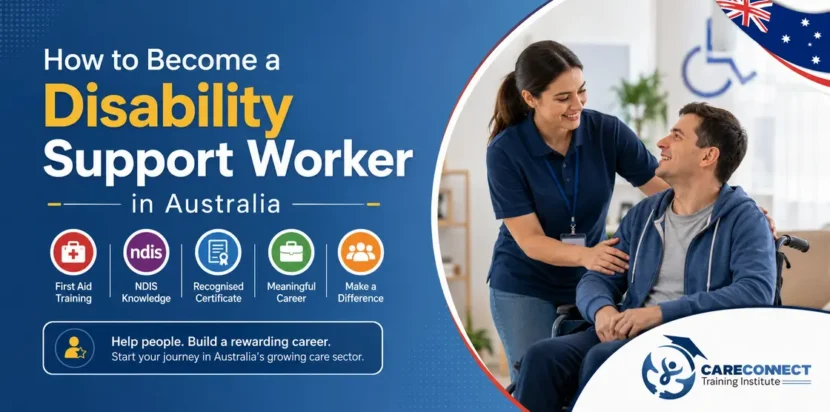
To become a disability support worker in Australia, most employers prefer candidates who complete the CHC33021 Certificate III in Individual Support, obtain relevant screening checks, hold a current First Aid and CPR certificate, and develop practical skills in person-centred care.
With growing demand across Australia, disability support offers a rewarding career with opportunities to work in homes, community settings, supported accommodation and disability service organisations.
📌 Key Takeaways
- Complete a CHC33021 Certificate III in Individual Support to improve your employment opportunities.
- Obtain employer-required checks such as an NDIS Worker Screening Check, Working With Children Check (where applicable) and First Aid/CPR certification.
- Develop practical skills including communication, empathy, manual handling, documentation and person-centred care.
- Disability support workers are employed by registered NDIS providers, community organisations, hospitals and home care providers across Australia.
- Career progression can lead to senior support roles, disability coordination, community services, allied health assistance and further study.
📑 Table of Contents
- What Does a Disability Support Worker Do?
- Why Choose Disability Support as a Career?
- Is Disability Support the Right career for You?
- Step-by-Step Guide to Becoming a Disability Support Worker
- What Qualifications Do You Need?
- Essential Checks and Certifications
- Skills Employers Look For
- Where Can You Work?
- Salary and Job Outlook
- Career Progression Pathways
- Final Thought
What Does a Disability Support Worker Do?
A disability support worker helps people with disability live as independently, safely and confidently as possible. Every person has different goals, abilities and support needs, so the role focuses on providing person-centred care rather than delivering the same support to everyone.
Depending on the participant’s individual support plan, a disability support worker may assist with:
- Personal care and hygiene
- Meal preparation
- Medication assistance (where trained and authorised)
- Mobility support
- Transport to appointments
- Household tasks
- Community participation
- Social inclusion
- Building independent living skills
- Emotional support
- Documentation and progress notes
- Working alongside families and allied health professionals
Rather than “doing everything” for someone, the goal is to promote independence and inclusion, empowering people to make choices and participate fully in everyday life.
Many disability support workers assist NDIS participants in achieving personal goals, whether that’s learning new skills, gaining employment, joining community activities or living more independently.
A Typical Day in the Role
No two days are exactly the same.
One morning you might support a participant with:
- Personal care
- Breakfast preparation
- Medication reminders
- Transport to work
Later in the day you may assist another participant with:
- Grocery shopping
- Community activities
- Exercise programs
- Social outings
- Developing independent living skills
Throughout the day you’ll document shift notes, communicate with your team and ensure support is delivered safely, professionally and according to each participant’s individual care plan.
This variety is one of the reasons many people find disability support both meaningful and rewarding.
Why Choose Disability Support as a Career?
According to Jobs and Skills Australia, demand across the health care and social assistance sector is expected to remain strong.
As a result, qualified disability support workers are needed across metropolitan, regional and rural Australia.
For many people, this career offers more than job security—it provides the opportunity to make a genuine difference in someone’s life every day.
Some of the key benefits include:
Strong Employment Demand
The healthcare and community services sector remains one of Australia’s fastest-growing employment industries, creating ongoing opportunities for qualified disability support workers.
Meaningful Work
Every shift gives you the opportunity to help people achieve greater independence, confidence and community participation.
Flexible Working Arrangements
Many employers offer:
- Casual positions
- Permanent employment
- Part-time work
- Full-time roles
- Weekend shifts
- Evening shifts
- Overnight support
This flexibility makes the profession attractive to career changers, parents and students.
Diverse Career Opportunities
Disability support workers can work in numerous environments, including:
- Client homes
- Community centres
- Residential disability services
- Supported Independent Living (SIL)
- Specialist Disability Accommodation (SDA)
- Hospitals
- Rehabilitation centres
- Day programs
- Schools
- Respite services
The variety means you can choose an environment that matches your interests and strengths.
Why More Australians Are Choosing Disability Support
People enter disability support for different reasons.
Some are seeking a stable healthcare career.
Others want work that aligns with their values.
Many career changers are attracted by the opportunity to build meaningful relationships while developing practical skills that are recognised throughout Australia’s care sector.
The profession also provides clear opportunities for ongoing learning and career advancement through nationally recognised qualifications and professional development.
Is Disability Support the Right Career for You?
Technical skills can be taught.
Personal qualities are just as important.
Successful disability support workers usually enjoy helping others while respecting each person’s choices, independence and dignity.
Ask yourself:
- Do you enjoy working with people?
- Are you patient and compassionate?
- Can you communicate clearly?
- Are you comfortable adapting to different situations?
- Do you remain calm under pressure?
- Can you maintain professional boundaries?
- Are you willing to keep learning?
If you answered “yes” to most of these questions, disability support could be an excellent career pathway.
Personal Qualities Employers Value
While qualifications help you get interviews, employers often hire people who demonstrate the right attitude.
Highly valued qualities include:
- Empathy
- Compassion
- Active listening
- Reliability
- Professionalism
- Patience
- Cultural awareness
- Adaptability
- Teamwork
- Problem-solving
- Time management
- Resilience
These qualities allow support workers to build trusting relationships while delivering safe, respectful and person-centred support.
Step-by-Step Guide to Becoming a Disability Support Worker
If you’re wondering how to become a disability support worker in Australia, following a structured pathway can make the process much easier.
Step 1: Learn About the Role
Before enrolling in a course, understand what disability support involves.
Research:
- Daily responsibilities
- Work environments
- Shift patterns
- Physical requirements
- Career opportunities
- Employer expectations
Speaking with current support workers or volunteering in community organisations can also provide valuable insight into the profession.
Step 2: Choose the Right Qualification
Although some employers may hire applicants without formal qualifications, completing a nationally recognised course significantly improves your employment prospects.
For most people, the recommended entry-level qualification is the:
CHC33021 Certificate III in Individual Support
This qualification develops practical knowledge and skills in areas such as:
- Person-centred care
- Supporting independence
- Communication
- Safe work practices
- Infection prevention and control
- Manual handling
- Personal care
- Documentation
- Working within legal and ethical frameworks
- Supporting people with disability and older Australians
Many graduates use this qualification to begin working in disability support, aged care or home and community care.
Many education providers also include practical vocational placement, allowing students to gain hands-on experience in real workplace environments.
💼 Career Tip
If you’re looking to begin a career in disability support, explore the Certificate III in Individual Support offered through Care Connect Training Institute.
The institute helps students connect with suitable education providers and nationally recognised training pathways that align with their career goals.
Flexible Study Options
Many students today choose flexible learning because it allows them to balance study with work and family commitments.
Depending on the education provider, study options may include:
- Online learning
- Blended delivery
- Face-to-face workshops
- Practical vocational placement
- Hybrid learning models
Choosing a study option that fits your schedule can help you complete your qualification while maintaining other commitments.
Mandatory vs Preferred Qualifications
Many people assume a qualification is legally required before working in disability support. In reality, there is an important distinction between legal requirements and employer expectations.
| Requirement | Mandatory | Preferred by Employers |
| CHC33021 Certificate III in Individual Support | ❌ | ✅ |
| Certificate IV in Disability Support | ❌ | ✅ (for senior roles) |
| First Aid & CPR | Sometimes | ✅ |
| NDIS Worker Screening Check | Often, depending on the role | ✅ |
| Working With Children Check | Only if supporting children | ✅ |
| Manual Handling Training | Employer dependent | ✅ |
| Medication Administration Training | Role dependent | ✅ |
Although not every position has identical requirements, candidates with recognised qualifications and relevant certifications are generally more competitive in the job market.
🎓 Explore Your Study Options
If you’re looking to begin your career, learn more about the Certificate III in Individual Support through Care Connect Training Institute.
The institute connects students with suitable education providers offering flexible study pathways and nationally recognised qualifications.
Recognition of Prior Learning (RPL)
Already working in disability support?
You may not need to start from the beginning.
Recognition of Prior Learning (RPL) allows experienced workers to have their existing knowledge, workplace skills and previous training assessed against nationally recognised qualification requirements.
RPL may be suitable if you have experience as a:
- Disability Support Worker
- Personal Care Assistant
- Community Care Worker
- Home Care Worker
- Support Worker
- Aged Care Worker
If your experience meets the competency requirements, you may be able to obtain a qualification without completing all training from scratch.
Certificate III in Individual Support RPL →
Step 3: Complete Your Training and Placement
Once you’ve enrolled in your chosen qualification, the focus shifts to developing practical knowledge and workplace skills.
Training usually combines classroom or online learning with practical assessments designed to prepare students for real-world care environments.
Many education providers also include vocational placement, giving students the opportunity to apply what they’ve learned under the supervision of experienced professionals.
During placement, you may gain experience in:
- Supporting daily living activities
- Assisting with personal care
- Communicating with participants and their families
- Following workplace policies and procedures
- Maintaining documentation and shift notes
- Working as part of a multidisciplinary care team
Practical placement is also an excellent opportunity to build confidence, develop professional relationships and gain valuable industry experience that can strengthen future job applications.
Step 4: Meet Employer and Compliance Requirements
Completing a qualification is only one part of becoming job-ready.
Many disability support employers require an NDIS Worker Screening Check, particularly for risk-assessed roles. Requirements vary depending on the employer, whether the provider is registered, the participant arrangement, and state or territory rules.
The exact requirements vary depending on your employer, state or territory, and the type of clients you support.
1. NDIS Worker Screening Check
If you work in a role that involves supporting NDIS participants in risk-assessed positions, you may need an NDIS Worker Screening Check.
This screening process helps determine whether an individual is suitable to work with people with disability by reviewing relevant criminal history and other risk information.
Requirements differ across Australian states and territories, so it’s important to check the rules that apply in your location.
2. NDIS Worker Orientation Module
Many disability employers encourage or require workers to complete the NDIS Worker Orientation Module, which introduces:
- the NDIS Code of Conduct
- participant rights
- professional responsibilities
- safe and ethical practice
- quality support principles
Completing the module demonstrates your understanding of the expectations placed on workers delivering NDIS-funded supports.
3. NDIS Code of Conduct
All NDIS workers are expected to follow the NDIS Code of Conduct, which outlines expectations around safe, respectful and ethical service delivery. Registered providers must ensure workers understand these obligations.
4. Working With Children Check (WWCC)
If your role involves supporting children or young people, you may also require a Working With Children Check (WWCC).
Not every disability support role requires this clearance, but employers providing services to minors commonly request it.
5. National Police Check
Although the NDIS Worker Screening Check has replaced police checks for many risk-assessed NDIS roles, some employers still request a National Police Check as part of their recruitment process or for non-NDIS positions.
Always follow the specific requirements outlined by your prospective employer.
6. Driver Licence
Many community-based support roles involve transporting participants to:
- medical appointments
- shopping
- employment
- recreational activities
- community programs
As a result, a valid Australian driver licence—and in some cases access to a reliable vehicle—may be preferred or required.
7. First Aid and CPR Certification
Current First Aid and CPR certification is highly valued across the disability sector.
These qualifications prepare support workers to respond appropriately during medical emergencies while waiting for professional assistance.
Some employers require these certifications before employment, while others allow staff to complete them shortly after commencing work.
8. Manual Handling Training
Supporting people with mobility needs often involves assisting with:
- transfers
- lifting techniques
- mobility equipment
- positioning
- fall prevention
Manual handling training helps reduce the risk of injury for both workers and participants by teaching safe movement techniques and the correct use of assistive equipment.
9. Medication Assistance Training
Some disability support workers assist participants with medication in accordance with organisational policies and individual care plans.
Depending on the role and employer, additional medication administration training may be required before undertaking these responsibilities.
10. Immunisation Requirements
Some healthcare providers and disability service organisations may request evidence of specific immunisations, particularly when supporting vulnerable participants.
Requirements vary between employers and jurisdictions, so check the organisation’s recruitment policies before applying.
Practical Work Placement
Employers consistently value candidates who have practical workplace experience.
Many nationally recognised courses include vocational placement, allowing students to apply classroom learning in real care environments under supervision.
During placement, students typically develop confidence in:
- assisting with personal care
- supporting daily living activities
- communicating with participants
- documenting care
- working within multidisciplinary teams
- applying infection prevention procedures
- maintaining professional boundaries
This practical experience often makes the transition into paid employment much smoother.
💡 Key Takeaway
Completing a recognised qualification is the first step, but becoming employment-ready also involves meeting workplace compliance requirements, developing practical skills and understanding how to deliver safe, respectful and person-centred support.
Investing in the right training and certifications can significantly improve your confidence, employability and long-term career opportunities in Australia’s growing disability services sector.
Essential Skills Employers Look For
Qualifications may help you get an interview, but employers also want candidates who can build trust, communicate effectively and deliver high-quality, person-centred support.
The most successful disability support workers combine technical knowledge with strong interpersonal skills, allowing them to respond confidently to each participant’s unique needs.
1. Communication Skills
Clear communication is one of the most valuable skills in disability support.
You’ll regularly communicate with:
- Participants
- Family members
- Support coordinators
- Team leaders
- Allied health professionals
- Nurses
- Occupational therapists (OTs)
- Physiotherapists
- Speech pathologists
Effective communication includes active listening, explaining information clearly, documenting support accurately and respecting each person’s preferred communication style.
2. Empathy and Compassion
Supporting people with disability requires genuine empathy.
Empathy means understanding another person’s experiences without making assumptions.
Compassion means responding respectfully while encouraging independence rather than creating dependence.
Participants value support workers who listen, respect their choices and treat them with dignity.
3. Person-Centred Care
One of the core principles of disability support is person-centred care.
Instead of asking:
“What do I want the participant to do?”
A support worker asks:
“What does this person want to achieve, and how can I help them achieve it safely?”
Person-centred care focuses on:
- Individual goals
- Choice and control
- Independence
- Inclusion
- Respect
- Cultural preferences
- Personal values
This approach aligns closely with the principles of the National Disability Insurance Scheme (NDIS).
4. Manual Handling Skills
Many participants require assistance with mobility and transfers.
Learning safe manual handling techniques helps reduce the risk of injury for both workers and participants.
Depending on the workplace, you may use:
- Hoists
- Slide sheets
- Wheelchairs
- Mobility aids
- Transfer equipment
Employers highly value workers who understand safe lifting practices and workplace health and safety requirements.
5. Documentation Skills
Good documentation protects both participants and support workers.
Accurate records help maintain continuity of care and ensure everyone involved understands the participant’s progress and support needs.
Examples include:
- Shift notes
- Incident reports
- Progress reports
- Medication records
- Behaviour observations
- Care plan updates
Clear, objective and timely documentation is an essential professional responsibility.
6. Professional Boundaries
Disability support workers often build strong relationships with participants.
However, maintaining professional boundaries is essential.
This includes:
- Respecting privacy
- Maintaining confidentiality
- Following organisational policies
- Avoiding conflicts of interest
- Acting ethically at all times
Professional boundaries help protect both participants and workers while fostering safe and respectful support relationships.
7. Cultural Competence
Australia’s disability sector supports people from many different cultural, religious and linguistic backgrounds.
Cultural competence involves:
- Respecting cultural beliefs
- Using inclusive communication
- Understanding diverse values
- Avoiding assumptions
- Providing culturally safe support
Employers increasingly seek workers who can provide respectful and inclusive care across diverse communities.
8. Positive Behaviour Support
Some participants may experience behaviours of concern that require specialised support.
While not every disability support worker will work in these environments, understanding the principles of Positive Behaviour Support (PBS) can be highly beneficial.
PBS focuses on:
- Understanding the reasons behind behaviour
- Reducing restrictive practices
- Promoting quality of life
- Building positive relationships
- Supporting skill development
Workers collaborate with behaviour support practitioners to implement approved support strategies safely and consistently.
9. Teamwork
Disability support is rarely a solo profession.
You may work alongside:
- Support coordinators
- Case managers
- Nurses
- Allied health professionals
- Families
- Community organisations
- Team leaders
Working collaboratively helps ensure participants receive coordinated, consistent and high-quality support.
10. Adaptability and Problem Solving
No two participants are the same.
Support workers often need to adapt to changing circumstances while remaining calm and professional.
Examples include:
- Adjusting daily routines
- Responding to unexpected situations
- Supporting changing health needs
- Solving practical challenges
- Managing competing priorities
Employers value workers who remain flexible while always placing participant safety and wellbeing first.
Step 5: Apply for Your First Disability Support Job
Once you’ve completed your training and any required checks, you’re ready to start applying for disability support positions.
To improve your chances of securing your first role:
- Prepare a professional resume highlighting your qualifications and transferable skills.
- Include details of your vocational placement and any relevant volunteering or community experience.
- Tailor your application to each employer.
- Practise answering common interview questions.
- Apply through reputable disability service providers and trusted job platforms.
Many graduates secure their first position through the organisation where they completed their vocational placement, making placement an excellent opportunity to build professional connections.
Step 6: Continue Your Professional Development
Learning doesn’t stop once you begin working.
As you gain experience, continuing your professional development can help you expand your knowledge, improve your skills and progress into more specialised or leadership roles.
Many disability support workers continue their education by completing:
- Certificate IV in Disability Support
- Certificate IV in Ageing Support
- Diploma of Community Services
- First Aid and CPR refresher training
- Manual handling updates
- Professional development workshops
With additional qualifications and workplace experience, you may progress into roles such as:
- Senior Disability Support Worker
- Team Leader
- Disability Services Coordinator
- Support Coordinator
- Case Manager
- Community Services Manager
Investing in ongoing learning helps you remain current with industry best practices while opening the door to new career opportunities within Australia’s health and community services sector.
What Does a Disability Support Worker Do Every Day?
Although every role is different, most disability support workers assist participants with activities that promote independence, wellbeing and community inclusion.
A typical shift may involve:
Personal Care
Providing assistance with:
- Showering
- Dressing
- Grooming
- Toileting
- Oral hygiene
Always respecting dignity, privacy and personal preferences.
Daily Living Support
Helping participants manage everyday activities such as:
- Meal preparation
- Household cleaning
- Laundry
- Grocery shopping
- Budgeting
- Transport
The aim is not simply to complete tasks but to encourage participants to build confidence and independence wherever possible.
Community Participation
Many participants want greater involvement in their communities.
Support workers may assist them to:
- Attend social events
- Participate in recreational activities
- Join sporting clubs
- Volunteer
- Access education
- Attend employment
Supporting community participation helps reduce social isolation and improve overall quality of life.
Emotional Support
Sometimes the most valuable support is simply being present.
Disability support workers build meaningful relationships by:
- Listening without judgement
- Encouraging independence
- Celebrating achievements
- Providing reassurance
- Promoting confidence
Strong, respectful relationships often have a lasting positive impact on participants.
Supporting Independent Living
Many participants choose to live independently with varying levels of support.
Support workers may assist with:
- Developing life skills
- Managing appointments
- Using public transport
- Cooking
- Financial management
- Building routines
These supports encourage long-term independence rather than dependence.
Working with NDIS Participants
Many disability support workers provide services funded through the National Disability Insurance Scheme (NDIS).
Participants may have supports funded under different categories, such as assistance with daily living, community participation or capacity building.
Understanding each participant’s support plan helps workers deliver services that align with agreed goals and outcomes.
Where Can Disability Support Workers Work?
One of the biggest advantages of this career is the variety of workplaces available.
Rather than working in a single environment, disability support workers can choose roles that match their interests, lifestyle and career goals.
Common workplace settings include:
Client Homes
Many workers provide in-home support, assisting participants to live safely and independently within their own homes.
Typical responsibilities include:
- Personal care
- Meal preparation
- Domestic assistance
- Medication support
- Community access
Supported Independent Living (SIL)
Supported Independent Living (SIL) provides assistance to people who live independently but require regular support with daily activities.
Workers in SIL homes often assist with:
- Daily routines
- Personal care
- Household management
- Skill development
- Social participation
Specialist Disability Accommodation (SDA)
SDA homes are designed for participants with very high support needs.
Workers in these settings often collaborate closely with nurses, therapists and multidisciplinary teams while supporting participants who require specialised equipment or complex care.
Community Centres
Community-based programs help participants build social connections and life skills.
Support workers may facilitate:
- Group activities
- Educational programs
- Community outings
- Recreational events
Residential Disability Services
Residential services provide ongoing support to people with disability who require regular assistance.
Support may include:
- Personal care
- Medication assistance
- Behaviour support
- Household management
- Community engagement
Hospitals and Rehabilitation Centres
Some disability support workers assist patients transitioning from hospital back into the community.
Working alongside healthcare professionals, they help participants regain confidence and independence during recovery.
Schools
Support workers may assist children or young people with disability in educational settings, helping them participate safely and confidently in school activities.
These positions often require a Working With Children Check (WWCC).
Respite Services
Respite care provides temporary support while family caregivers take a break.
Support workers ensure participants continue receiving quality care in a safe and supportive environment.
Aged Care Facilities
Many workers move between disability support and aged care during their careers because both sectors require similar foundational skills.
If you’re unsure which pathway suits you best, compare the two career options in our guide:
You can also read:
Aged Care vs Disability Support: Which Career Is Better?
Understanding SIL and SDA
These two terms often confuse new support workers.
Supported Independent Living (SIL)
SIL refers to funded supports that help participants develop everyday living skills while living independently or in shared accommodation.
Support workers assist participants with daily activities while encouraging choice, independence and community inclusion.
Specialist Disability Accommodation (SDA)
SDA refers to specially designed housing for people with extreme functional impairment or very high support needs.
Not every disability support worker will work in SDA, but understanding the difference between SIL and SDA demonstrates broader industry knowledge during interviews.
💡 Key Takeaway
The best disability support workers combine nationally recognised training with practical skills, empathy and professionalism.
Employers value candidates who understand person-centred care, communicate effectively, maintain professional boundaries and adapt confidently to different workplace settings.
Whether supporting someone at home, in the community or within Supported Independent Living (SIL), your role is to empower people with disability to live with greater independence, confidence and dignity.
📝 Note
Actual earnings vary based on your employer, award, location, hours worked, weekend or overnight shifts, qualifications and responsibilities.
Always check current job advertisements and applicable industrial awards, such as the SCHADS Award, for the most up-to-date pay information.
Disability Support Worker Salary in Australia
One of the biggest reasons people consider a career in disability support is the combination of meaningful work and strong employment opportunities.
While salaries vary depending on your experience, qualifications, employer, location and shift penalties, disability support offers competitive pay and clear opportunities for career progression.
How Much Does a Disability Support Worker Earn?
As a general guide, disability support workers in Australia may earn:
| Experience Level | Typical Annual Salary* |
| Entry-Level | AUD $60,000–$70,000 |
| Experienced Support Worker | AUD $70,000–$85,000 |
| Senior Disability Support Worker | AUD $85,000+ |
Factors That Influence Your Salary
Several factors can affect your earning potential.
Qualifications
Employers often value candidates who hold nationally recognised qualifications such as:
- CHC33021 Certificate III in Individual Support
- Certificate IV in Disability Support
- Diploma of Community Services
Higher qualifications may open doors to supervisory and leadership positions.
Experience
As your confidence and practical skills grow, you’ll generally become eligible for more specialised and higher-paying roles.
Workers with experience supporting:
- Complex care
- Behaviour support
- Supported Independent Living (SIL)
- High-intensity supports
may have access to additional career opportunities depending on employer requirements.
Shift Penalties
Many disability services operate 24 hours a day.
You may receive higher rates when working:
- Evening shifts
- Overnight shifts
- Weekends
- Public holidays
Penalty rates vary depending on your employment agreement and applicable award.
Location
Demand for disability support workers exists across Australia.
Some regional and remote communities may offer additional incentives or experience ongoing workforce shortages, creating increased employment opportunities.
Job Outlook in Australia
The future for disability support workers looks promising.
Australia’s ageing population, growing disability services sector and continued demand for personalised support mean employers continue to recruit qualified workers.
Growth has been influenced by:
- Expansion of disability services
- Increased community-based support
- Growth of the National Disability Insurance Scheme (NDIS)
- Greater focus on independent living
- Rising demand for person-centred care
For people looking for long-term employment, disability support remains one of Australia’s most resilient healthcare career pathways.
Why Demand Continues to Grow
The disability sector is changing.
More Australians are choosing to receive personalised support within their homes and communities instead of institutional settings.
This creates opportunities across:
- Home care
- Community participation
- Supported Independent Living (SIL)
- Specialist Disability Accommodation (SDA)
- Community programs
- Disability service organisations
Workers who combine practical experience with nationally recognised qualifications are well positioned to benefit from this continued growth.
Career Progression Pathways
Disability support isn’t simply an entry-level job.
It can become the foundation of a rewarding long-term healthcare career.
Many professionals continue developing their skills through additional qualifications and workplace experience.
🚀 Typical Career Pathway
Others choose to specialise or continue studying in related healthcare fields.
Possible progression includes:
- Allied Health Assistant
- Mental Health Support Worker
- Community Services
- Aged Care
- Nursing
- Occupational Therapy support roles
- Rehabilitation support
Continue Building Your Qualifications
As your career develops, additional study may improve your opportunities.
Popular pathways include:
Certificate IV in Disability Support
Ideal for experienced support workers wanting to develop leadership and advanced support skills.
Certificate IV in Ageing Support
Suitable for workers interested in expanding into aged care leadership roles.
Many professionals complete this qualification before progressing into coordination or management positions within the community services sector.
International Students and Visa Considerations
Many international students ask whether disability support is a good career in Australia.
The answer depends on your personal circumstances, study pathway and current Australian visa requirements.
Before making any decisions, always seek advice from your education provider, registered migration agent or the relevant Australian Government department.
If you’re an international student considering this career, think about:
- Course eligibility
- Work rights
- Practical placement requirements
- English language proficiency
- Future study pathways
- Employment opportunities after graduation
Because migration and visa policies can change, it’s important to rely on current government information rather than social media or unofficial advice.
Common Interview Questions
Preparing for interviews can significantly improve your confidence.
Here are some questions employers commonly ask.
Why do you want to become a disability support worker?
Employers want to understand your motivation and whether you genuinely enjoy helping people.
Focus on:
- Supporting independence
- Building meaningful relationships
- Making a positive difference
- Working in a rewarding career
How would you handle a challenging situation?
Interviewers want evidence of:
- Problem solving
- Professionalism
- Communication
- Participant safety
Use real examples whenever possible.
What does person-centred care mean to you?
Strong answers should explain that person-centred care involves:
- Respecting individual choices
- Supporting independence
- Listening to participants
- Working towards personal goals
- Protecting dignity
How do you manage confidential information?
Employers expect workers to:
- Respect privacy
- Follow workplace policies
- Maintain professional boundaries
- Share information only with authorised people
Describe a time you worked in a team.
Even if you haven’t worked in disability support before, examples from hospitality, retail, volunteering or previous employment demonstrate teamwork and communication skills.
Common Mistakes New Support Workers Make
Starting a new career is exciting, but avoiding common mistakes can help you build confidence and professionalism from day one.
1. Thinking the Job Is Only About Personal Care
Personal care is only one aspect of the role.
Support workers also help participants build confidence, independence, life skills and community connections.
2. Forgetting Person-Centred Care
Every participant has different goals, preferences and support needs.
Avoid making assumptions or treating every client the same.
3. Poor Documentation
Incomplete or inaccurate shift notes can affect continuity of care.
Always record information clearly, objectively and promptly according to workplace policies.
4. Ignoring Professional Boundaries
Being friendly is important.
Becoming overly involved in a participant’s personal life is not.
Maintaining professional boundaries protects both workers and participants.
5. Not Continuing Professional Development
Healthcare continues to evolve.
Successful support workers regularly update their knowledge through:
- Professional development
- Workplace training
- First Aid refreshers
- CPR renewal
- Manual handling updates
- Industry workshops
Lifelong learning helps you remain confident, competent and employable.
Final Thoughts
A career in disability support is about more than finding a job—it’s about empowering people to live with greater independence, dignity and inclusion. By combining nationally recognised training, practical experience and a commitment to person-centred care, you’ll be well placed to contribute to one of Australia’s most important and rewarding sectors.
Whether you’re just beginning your journey or looking to advance your existing skills, taking the next step towards quality training can help you build a meaningful and sustainable career in disability support.
Ready to Start Your Disability Support Career?
Choosing the right training pathway is one of the most important steps towards becoming a disability support worker.
Care Connect Training Institute helps students explore nationally recognised study options and connect with suitable education providers based on their career goals.
Whether you’re starting your first healthcare qualification or exploring Recognition of Prior Learning (RPL), the team can guide you towards the pathway that best suits your needs.
🎓 Explore Your Study Options
Ready to start your career in Australia’s care sector? Explore the study pathways below and find the option that best matches your goals.
⚠️ Disclaimer
Care Connect Training Institute is not an RTO or a CRICOS registered organisation. It provides guidance to help students choose suitable courses at best price and education providers based on their career goals.
Course information is provided for general guidance only and should not be considered professional or educational advice. Always confirm course details, entry requirements, fees and delivery options directly with the relevant education provider before enrolling.
Find answers to common questions
Frequently Asked Questions
The time required depends on your study mode and education provider. Many students complete the CHC33021 Certificate III in Individual Support within 6–12 months, although flexible and part-time study options may take longer. If you already have relevant workplace experience, you may also be eligible for Recognition of Prior Learning (RPL).
While there is no universal legal requirement for every disability support role, most Australian employers prefer applicants with a nationally recognised qualification, such as the CHC33021 Certificate III in Individual Support. Completing formal training demonstrates that you have the knowledge and practical skills required to provide safe, person-centred support.
Many employers prefer or require workers to hold current First Aid and CPR certification, particularly when supporting participants with higher care needs. Requirements vary between organisations, so check the specific expectations of your prospective employer.
Many international students choose disability support as a career pathway. However, eligibility to study, work and undertake placements depends on individual circumstances and visa conditions. Always seek advice from your education provider and refer to current Australian Government information before making decisions.
Supported Independent Living (SIL) refers to funded support services that help participants live independently, while Specialist Disability Accommodation (SDA) refers to purpose-built housing designed for people with very high support needs. Support workers may work in both environments depending on their employer and the needs of participants.
Yes. Many employers recruit entry-level candidates who have completed relevant training and demonstrate the right attitude. Practical placement completed during your qualification can also provide valuable workplace experience.
Some roles involve assisting with mobility, transfers and personal care. Safe manual handling techniques, appropriate equipment and workplace training help minimise risks. The level of physical activity varies depending on the participant's support needs.

Comments are closed