
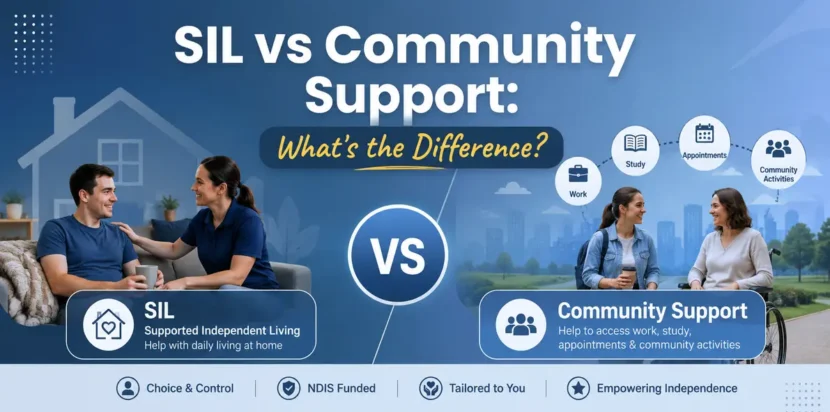
Supported Independent Living (SIL) provides ongoing assistance for people with higher support needs in their home, while Community Support helps people participate in everyday life through social, recreational, educational, and community activities. Depending on their goals and approved funding, many National Disability Insurance Scheme (NDIS) participants may receive both types of support.
The National Disability Insurance Scheme (NDIS) is an Australian Government program that funds reasonable and necessary supports for eligible people with permanent and significant disabilities. Within the NDIS, SIL and Community Support are designed to meet different needs rather than compete with each other.
It’s also important to understand that the NDIS is based on the principles of choice and control, giving participants greater flexibility to decide how, when, and by whom their approved supports are delivered. This helps ensure disability services are tailored to individual goals rather than a one-size-fits-all approach.Â
In this guide, you’ll learn the key differences between SIL and Community Support, who each service is designed for, how they are funded, and when both supports may be included in an NDIS plan. Whether you’re an NDIS participant, a family member, or considering a career in disability support, understanding these services will help you make more informed decisions.
What Is Supported Independent Living (SIL)?
Supported Independent Living (SIL) is a type of National Disability Insurance Scheme (NDIS) support that helps people with higher support needs live as independently as possible by providing regular assistance with everyday tasks in their home. It is designed for people who require ongoing support rather than occasional help.
Supported Independent Living (SIL) is funded through the National Disability Insurance Scheme (NDIS), an Australian Government program that provides eligible people with funding for reasonable and necessary disability supports. SIL falls under the NDIS Home and Living supports and focuses on the support a person receives rather than the accommodation itself.
SIL is commonly provided in shared homes where participants live with others and receive support from trained disability support workers. However, depending on individual circumstances and approved funding, SIL may also be delivered in a participant’s own home.
Support workers assist with a wide range of daily living activities, including:
- Personal care, such as showering and dressing
- Meal planning and preparation
- Household cleaning and laundry
- Medication reminders or assistance where appropriate
- Developing independent living skills
- Building daily routines and confidence
- Overnight or 24-hour support when required
The level of support varies based on each participant’s functional needs, goals, and NDIS plan. While some people require assistance throughout the day and night, others may only need support during specific parts of the day.
Australian Example
Sarah is an NDIS participant with significant physical support needs who lives in a shared home with two other participants in Melbourne. Support workers assist her with personal care each morning, meal preparation, household tasks, and daily routines while encouraging her to build greater independence over time. Her SIL funding covers the support she receives, while her accommodation costs are assessed separately.
Expert Tip
SIL funds the support provided to help someone live independently — it does not automatically pay for the home itself. Accommodation and support are assessed separately under the NDIS, so it’s important to understand the difference when exploring Home and Living options.
What Is Community Support?
Community Support helps people with disability participate in everyday life by providing assistance to access their local community, build social connections, develop life skills, and achieve personal goals. Unlike Supported Independent Living (SIL), Community Support mainly focuses on activities outside the home rather than ongoing daily living assistance.
Community Support includes a wide range of services that enable people to live more active, independent, and inclusive lives. Under the National Disability Insurance Scheme (NDIS), many of these supports are funded through Core Supports or Capacity Building Supports, depending on a participant’s approved plan and individual goals.
One point that often causes confusion is that Community Support is a commonly used service description rather than a single official NDIS funding category. Depending on a participant’s approved plan, these services may be funded through Core Supports, Capacity Building Supports, or other relevant support budgets. The exact funding depends on the participant’s goals and assessed needs.Â
Rather than providing continuous in-home assistance, Community Support is designed to help participants engage with their community, increase independence, and improve their confidence in everyday situations.
Common Community Support activities include:
- Attending medical or allied health appointments
- Participating in social and recreational activities
- Shopping and running everyday errands
- Using public transport or travelling safely in the community
- Attending education, training, or employment programs
- Building communication and independent living skills
- Participating in volunteering or community events
Community Support is highly flexible. Participants may receive assistance for a few hours each week or more regularly, depending on their NDIS plan, personal goals, and support needs.
Australian Example
David is an NDIS participant living independently in Brisbane. He manages his personal care without assistance but receives Community Support each week to attend a local fitness program, travel to TAFE classes, complete grocery shopping, and participate in community events. These supports help him develop confidence, maintain social connections, and work towards greater independence.
Expert Tip
Community Support is not only about attending activities. A skilled disability support worker helps participants build practical skills, confidence, and independence so they can gradually achieve more on their own, rather than becoming dependent on ongoing support.
SIL vs Community Support: Key Differences at a Glance
Supported Independent Living (SIL) provides ongoing in-home support for people with higher support needs, while Community Support helps people participate in everyday community life, build independence, and achieve personal goals. The two services are designed for different purposes and often work together as part of an NDIS plan.
Although both supports promote independence and improve quality of life, they are not interchangeable. SIL focuses on helping participants manage daily living at home, whereas Community Support encourages social inclusion, skill development, and active participation in the community.
The table below highlights the main differences.
|
Feature |
Supported Independent Living (SIL) |
Community Support |
|
Primary purpose |
Support with daily living and independent living at home |
Support to access the community and achieve personal goals |
|
Where support is provided |
Primarily in the participant’s home or shared supported accommodation |
Mainly in community settings such as shops, workplaces, education, and recreational venues |
|
Support level |
Ongoing or higher-level daily support |
Flexible support based on individual activities and goals |
|
Personal care |
Commonly includes personal care, meal preparation, and household tasks |
May include limited personal assistance during community outings if required |
|
Community participation |
Not the primary focus, although community access may be included |
Core focus is social participation, community access, and inclusion |
|
Living arrangements |
Often provided in shared supported accommodation or a participant’s own home |
Available regardless of where the participant lives |
|
NDIS funding |
Typically funded under Home and Living supports within the NDIS |
Commonly funded through Core Supports or Capacity Building Supports, depending on the participant’s plan |
|
Typical participants |
People with higher or ongoing support needs who require regular assistance at home |
People who want support to participate in education, employment, volunteering, appointments, or community activities |
Expert Observation
One of the most common misconceptions is that participants must choose between SIL and Community Support. In reality, many National Disability Insurance Scheme (NDIS) participants benefit from both. For example, a person may receive SIL each day to assist with personal care and household routines while also accessing Community Support to attend TAFE, volunteer, join social groups, or participate in recreational activities.
Practical Advice
When comparing SIL vs Community Support, focus on the participant’s goals rather than the service name. If the primary need is ongoing assistance with everyday living at home, SIL may be appropriate. If the goal is to build confidence, increase social participation, or access education and employment opportunities, Community Support is often the better fit. Many participants achieve the best outcomes by combining both supports within their approved NDIS plan.
Can You Receive Both SIL and Community Support?
Yes. Many National Disability Insurance Scheme (NDIS) participants receive both Supported Independent Living (SIL) and Community Support because the two services meet different needs. SIL helps with everyday living at home, while Community Support enables participants to access education, employment, appointments, social activities, and their local community.
Receiving both supports depends on a participant’s individual circumstances, goals, functional capacity, and approved NDIS plan. During the planning process, the National Disability Insurance Agency (NDIA) assesses what supports are considered reasonable and necessary to help the participant achieve their goals.
For example, a participant may receive:
- Supported Independent Living (SIL) each day for personal care, meal preparation, medication routines, and household tasks.
- Community Support several times a week to attend TAFE, travel to medical appointments, volunteer, participate in sports, or enjoy social activities.
These supports work together to promote greater independence rather than serving the same purpose.
Australian Example
Michael lives in supported accommodation in Adelaide and receives SIL every day to help with cooking, personal care, and managing his daily routine. On weekdays, a disability support worker also provides Community Support by assisting him to attend a local employment program, use public transport, and participate in a community gardening group. Together, these supports help Michael live more independently both at home and in the wider community.
Common Mistake to Avoid
A common misconception is that approval for Supported Independent Living (SIL) automatically includes Community Support. In reality, each support is assessed separately against a participant’s NDIS goals and funding. Having one support does not guarantee eligibility for the other.
Practical Advice
If you’re unsure whether SIL, Community Support, or both are suitable, discuss your daily support needs and long-term goals with your NDIS Support Coordinator or planner. A clear understanding of your living arrangements, independence goals, and community participation objectives can help ensure your NDIS plan includes the most appropriate supports.
During an NDIS planning or plan review meeting, participants may also receive guidance from a Local Area Coordinator (LAC) or Support Coordinator, depending on their circumstances and plan. These professionals can help identify whether SIL, community participation services, or a combination of both is appropriate to achieve a participant’s goals.
Which Option Is Right for You?
The right choice depends on your support needs and personal goals. Supported Independent Living (SIL) is generally suitable for people who need regular assistance with daily living at home, while Community Support is ideal for those who want help accessing their community, building independence, and participating in everyday activities. Some National Disability Insurance Scheme (NDIS) participants benefit from both supports.
When deciding between SIL vs Community Support, it’s important to consider the level of assistance you need, where you need that support, and what you want to achieve. The goal isn’t to choose the “better” service—it’s to identify the support that best matches your lifestyle and NDIS goals.
Choose Supported Independent Living (SIL) if you:
- Need regular support with personal care and daily routines.
- Require assistance with cooking, cleaning, or household tasks.
- Need overnight or around-the-clock support.
- Live, or plan to live, in supported accommodation.
- Want to develop independent living skills with ongoing assistance.
- Have higher support needs that make living independently challenging without regular help.
Choose Community Support if you:
- Want to become more active in your local community.
- Need assistance attending medical appointments or shopping.
- Would like support to access education, employment, or volunteering.
- Want to build social connections and reduce isolation.
- Need help using public transport or travelling safely.
- Want to improve confidence and life skills while living more independently.
Decision Checklist
Use this quick guide to determine which support may better suit your circumstances.
|
Your Goal |
Recommended Support |
|
Receive daily assistance at home |
Supported Independent Living (SIL) |
|
Build independent living skills |
Supported Independent Living (SIL) |
|
Attend social or recreational activities |
Community Support |
|
Access education or employment |
Community Support |
|
Receive help with household routines |
Supported Independent Living (SIL) |
|
Improve community participation and confidence |
Community Support |
|
Need support both at home and in the community |
A combination of SIL and Community Support may be appropriate |
Practical Advice
Before requesting funding, think about what you need help with on a typical day. If most challenges occur at home, Supported Independent Living (SIL) may be the more appropriate option. If your main goal is to participate in work, study, social activities, or community life, community-based assistance may better align with your needs. Many participants achieve the best outcomes by combining both supports where appropriate under their approved NDIS plan.
Final Thoughts
Supported Independent Living (SIL) and Community Support are not competing services—they are complementary supports that help National Disability Insurance Scheme (NDIS) participants achieve different goals. SIL focuses on daily living assistance at home, while Community Support promotes independence through social participation, education, employment, and community engagement.
Understanding the difference between SIL vs Community Support can help participants, families, and carers make informed decisions about the supports that best match individual needs. While some people only require one type of support, others benefit from a combination of both to live more independently and participate fully in their community.
If you’re considering a career in Australia’s disability sector, knowing how these supports work is equally important. Disability support workers play a vital role in delivering person-centred care, helping participants achieve their goals, build confidence, and improve their quality of life.
Whether you’re exploring NDIS services or preparing for a career in disability support, having a clear understanding of SIL and Community Support is a valuable first step.
🎓 Explore Your Study Options
Ready to start your career in Australia’s care sector? Explore the study pathways below and find the option that best matches your goals.Find answers to common questions
Frequently Asked Questions
Yes. Supported Independent Living (SIL) is generally intended for National Disability Insurance Scheme (NDIS) participants who require ongoing or higher levels of daily support to live safely and independently.
Sometimes. Community Support can include personal assistance when it is directly related to helping a participant access community activities, but its primary purpose is community participation rather than ongoing personal care.
Yes. Supported Independent Living (SIL) can be provided in a participant's own home or in shared supported accommodation, depending on their approved NDIS plan and support needs.
Yes. Community Support can assist participants in accessing education, training, employment, volunteering, and other community-based activities when these supports align with their NDIS goals.
Yes. The National Disability Insurance Scheme (NDIS) may fund both Supported Independent Living (SIL) and Community Support if they are considered reasonable and necessary to help a participant achieve their goals.
Yes. Community Support may include assistance with transport when it is directly related to achieving a participant's approved NDIS goals, such as attending work, study, medical appointments, or community activities.


Comments are closed