
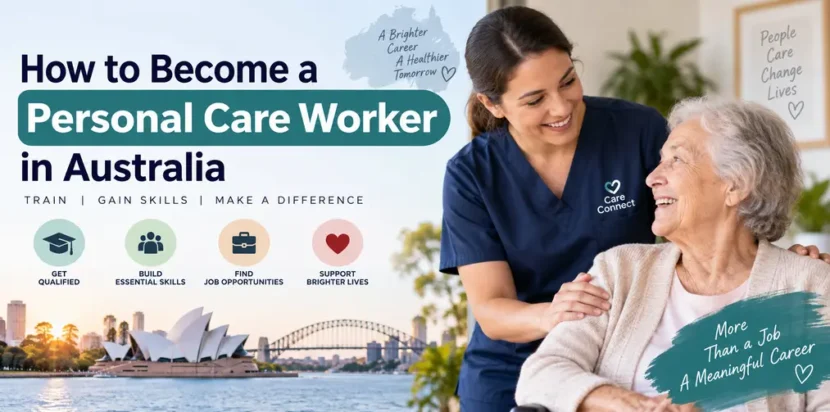
A Personal Care Worker (PCW) supports people who need assistance with personal care and everyday activities. Depending on the role, you may work in residential aged care, home care, community services or disability support.
There is no single qualification that applies to every Personal Care Worker position across Australia. However, relevant vocational training is an important pathway into individual support and aged care, and employers or service providers can have their own qualification, screening and experience requirements.
For people starting in individual support, CHC33021 Certificate III in Individual Support is one of the key qualifications to investigate. The qualification covers person-centred support in community, home and residential care settings and includes a minimum of 120 hours of work under its assessment requirements.
This guide explains what Personal Care Workers do, which qualifications may be relevant, what checks and skills you may need, how RPL works and how to prepare for your first job.
QUICK ANSWER
How Do You Become a Personal Care Worker in Australia?
A typical pathway to becoming a Personal Care Worker is:
- 01
Understand the type of personal care workyou want to do. - 02
Choose a relevant nationally recognised qualificationor RPL pathway. - 03
Complete the required trainingand practical workplace requirements. - 04
Meet the screening and employer requirementsfor your chosen role. - 05
Prepare a care-focused resumeand supporting documents. - 06
Apply for suitable Personal Care Worker,aged care or support worker positions. - 07
Build workplace experienceand continue developing your skills.
The exact pathway depends on the sector, job, employer and state or territory.
If you’re considering aged care specifically, you can also read our guide on how to become an aged care worker in Australia.
What Is a Personal Care Worker?
A Personal Care Worker provides practical assistance to people who need support with personal care and daily living.
The role can include helping with:
- Personal hygiene
- Showering and bathing
- Dressing
- Grooming
- Mobility
- Eating and drinking
- Daily living activities
- Social and emotional support
- Maintaining independence
- Following individualised care plans
- Reporting relevant observations
- Completing workplace documentation
In the aged care sector, direct care can include assisting with daily living activities, personal hygiene and people’s physical and cognitive needs. Fair Work also distinguishes direct care employees from workers performing general support functions.
The actual duties of a Personal Care Worker depend on the position, workplace and person’s support needs.
Where Do Personal Care Workers Work?
Personal Care Workers can work across several care environments.
Residential aged care
In residential aged care, Personal Care Workers may support residents with personal care, daily routines, mobility and other activities.
Home care
Home care workers provide support in a person’s own home. The focus can include personal care, daily living and helping the person maintain independence.
Community care
Community-based roles may involve supporting people to participate in activities, access services and remain connected with their community.
Disability support
Personal care can also form part of disability support. Depending on the role, a disability support worker may provide personal care alongside broader support aimed at independence, community participation and wellbeing.
If you’re deciding between home-based and residential work, our guide to home care vs residential aged care provides a useful comparison.
Do You Need a Qualification to Become a Personal Care Worker?
There is no single qualification that is universally mandatory for every Personal Care Worker position in Australia. Requirements can vary according to the sector, role, employer and applicable regulatory requirements.
However, relevant vocational qualifications are an important pathway into individual support and aged care.
For example, CHC33021 Certificate III in Individual Support is a current nationally recognised qualification covering person-centred support for people who may require assistance because of ageing, disability or another reason. It applies across community, home and residential care settings.
For aged care, employers and providers may have specific requirements relating to workers’ qualifications, skills and experience. Employment classification can also depend on duties, responsibility, experience and qualifications.
So rather than assuming that every Personal Care Worker needs exactly the same certificate, check the requirements of the specific job and care setting.
Personal Care Worker Requirements in Australia
The requirements for a Personal Care Worker can vary. A useful way to understand them is to separate qualification, screening and employer requirements.
|
Requirement |
Does it apply to every Personal Care Worker? |
|
Relevant qualification |
No — depends on the role and employer |
|
Practical training |
Depends on the qualification |
|
Police check |
Depends on the employer and applicable requirements |
|
NDIS Worker Screening Check |
Required for relevant risk-assessed NDIS roles |
|
First Aid or CPR |
Depends on the role and employer |
|
Driver’s licence |
Depends on the position |
|
Previous experience |
Depends on the employer |
|
Working With Children Check |
Relevant where the role involves children |
This distinction is important. An employer requirement is not automatically a national legal requirement.
Before applying, read the job advertisement carefully and check the requirements with the employer if anything is unclear.
Which Qualification Is Suitable for a Personal Care Worker?
Your ideal training pathway depends on the type of care work you want to pursue.
|
Qualification |
Main career direction |
When to investigate it |
|
CHC33021 Certificate III in Individual Support |
Individual support, ageing and disability |
Starting a career in support work |
|
CHC43015 Certificate IV in Ageing Support |
Specialised aged care |
Developing an aged care career |
|
CHC43121 Certificate IV in Disability Support |
Disability support |
Focusing on disability services |
These qualifications are not interchangeable in every situation. Always check the qualification details, specialisation, assessment requirements and employer expectations before enrolling.
CHC33021 Certificate III in Individual Support
CHC33021 Certificate III in Individual Support is one of the main qualifications to investigate if you’re starting a career in individual support.
The National Training Register describes the qualification as covering people working in community, home or residential care settings who provide person-centred support under supervision and delegation.
CHC33021 has specialisations in:
- Ageing
- Disability
- Ageing and Disability
The qualification also requires candidates to complete at least 120 hours of work as specified in the assessment requirements.
If you’re considering this pathway, you can explore CHC33021 Certificate III in Individual Support.
CHC43015 Certificate IV in Ageing Support
CHC43015 Certificate IV in Ageing Support is focused specifically on specialised aged care support.
The current qualification covers specialised tasks and functions in aged services across residential, home and community environments. It has a minimum work requirement of 120 hours and currently has no entry requirements listed on the National Training Register.
The qualification’s occupational classifications include roles such as:
- Personal Care Worker
- Personal Care Assistant
- Residential Care Worker
- Support Worker
- Care Team Leader
If aged care is your intended career direction, you can explore Certificate IV in Ageing Support.
CHC43121 Certificate IV in Disability Support
If your intended career direction is disability support, CHC43121 Certificate IV in Disability Support is another qualification to investigate.
It focuses on providing support to people with disability in community settings and people’s homes, with an emphasis on independence, self-reliance, community participation and wellbeing.
Importantly, CHC43121 has specific entry requirements, so it should not simply be treated as a direct replacement for Certificate III for someone starting from zero.
You can learn more about Certificate IV in Disability Support.
Personal Care Worker vs Personal Care Assistant
The terms Personal Care Worker (PCW) and Personal Care Assistant (PCA) can overlap.
In many aged care environments, both terms can describe workers involved in direct personal care and daily living support. However, job titles are not a reliable way to determine exactly what a position involves.
Always look at:
- The position description
- Required qualifications
- Duties
- Level of responsibility
- Workplace setting
- Employer requirements
For example, the current CHC43015 qualification includes both “Personal Care Worker” and “Personal Care Assistant” within its occupational classifications.
Personal Care Worker vs Aged Care Worker
These terms are related but can describe different levels of work.
A Personal Care Worker generally focuses on direct personal care and daily living assistance.
An Aged Care Worker is a broader term that can refer to different workers across the aged care sector.
For example, a Personal Care Worker may assist with:
- Showering
- Dressing
- Grooming
- Mobility
- Eating
- Daily activities
Other aged care employees may work in lifestyle, food services, administration, cleaning or other functions.
Fair Work’s Aged Care Award separates employees into direct care and general support streams, with classification depending on duties, responsibility, experience and qualifications.
Personal Care Worker vs Support Worker
“Support Worker” is a broader job title that can cover different sectors and responsibilities.
|
Job title |
Typical focus |
|
Personal Care Worker |
Personal care and daily living assistance |
|
Personal Care Assistant |
Often direct personal care, particularly in aged care |
|
Support Worker |
Broader support depending on the sector |
|
Disability Support Worker |
Individualised support for people with disability |
|
Aged Care Worker |
Broader terminology covering different aged care roles |
These categories can overlap. The actual responsibilities depend on the employer and position.
If you’re considering disability support as an alternative career direction, read how to become a disability support worker in Australia.
Step-by-Step: How to Become a Personal Care Worker in Australia
Step 1: Choose Your Preferred Care Setting
Start by deciding which type of work interests you.
You could consider:
- Residential aged care
- Home care
- Community care
- Disability support
- Supported living
- Other individual support services
You don’t necessarily need to make a permanent decision at this stage, but knowing your preferred direction can help you select appropriate training.
Step 2: Choose an Appropriate Qualification
If you’re starting without a relevant formal qualification, investigate a nationally recognised qualification that matches your intended career direction.
For many people entering individual support, CHC33021 Certificate III in Individual Support is an important pathway to investigate.
If your focus is specialised aged care, CHC43015 Certificate IV in Ageing Support may be relevant.
Before enrolling, check:
- Qualification code
- Specialisation
- Current qualification status
- Work placement requirements
- Assessment requirements
- RTO details
- Course delivery arrangements
- Entry requirements
Don’t choose a course based only on a marketing name such as “Personal Care Worker Course”.
Our guide on how to choose the right RTO for a healthcare course can help you understand what to check before enrolling.
Step 3: Complete Your Training and Practical Requirements
Personal care is practical work.
You need more than theoretical knowledge to safely support another person.
For example, CHC33021 requires at least 120 hours of work under its assessment requirements.
Depending on your qualification and training provider, practical experience can help you develop skills in:
- Person-centred support
- Personal care
- Communication
- Mobility assistance
- Safe work practices
- Documentation
- Professional boundaries
- Working with supervisors
- Responding appropriately to individual needs
Always check the practical requirements of your particular qualification and RTO.
Step 4: Meet Relevant Screening Requirements
Screening requirements vary according to the sector, role, employer and jurisdiction.
NDIS Worker Screening Check
If you work for a registered NDIS provider in a relevant risk-assessed role, you may need an NDIS Worker Screening Check.
The NDIS Quality and Safeguards Commission states that the check applies to workers such as employees, volunteers, contractors and students working for registered providers in risk-assessed or key personnel roles. NDIS Worker Screening Checks are valid for up to five years.
You can learn more in our detailed guide to the NDIS Worker Screening Check.
Police checks
A National Police Check may be requested by an employer or required under applicable arrangements.
The exact process can vary, so don’t assume that every Personal Care Worker position has identical requirements.
For more information, read our guide to the National Police Check for aged care jobs in Australia.
Working With Children Check
A Working With Children Check is relevant when a role involves working with children.
It should not automatically be treated as a requirement for every adult aged care or personal care position.
What Skills Do Personal Care Workers Need?
A qualification is only one part of working effectively in personal care.
Employers may look for a combination of practical knowledge, interpersonal skills and professional behaviour.
Communication
You need to communicate respectfully with clients, residents, participants, families, carers, supervisors and other professionals.
Privacy and dignity
Personal care can involve intimate activities. Workers need to protect privacy and dignity while supporting a person’s choices.
Person-centred care
Support should be based on the individual’s needs, preferences, goals and circumstances rather than applying exactly the same approach to everyone.
Personal care skills
Depending on the role, this can include assisting with hygiene, dressing, grooming, mobility and daily living activities.
Observation and reporting
Workers may need to notice relevant changes and communicate concerns through the appropriate workplace processes.
Professional boundaries
Understanding your responsibilities and the limits of your role is essential in care work.
Documentation
Depending on the workplace, workers may need to complete progress notes, records or other documentation.
Safe work practices
Manual handling, infection prevention and workplace safety can be important depending on the position.
For more on the interpersonal side of support work, read Essential Soft Skills Every Support Worker Needs.
Do Personal Care Workers Need First Aid or CPR?
First Aid and CPR can be relevant to care-sector employment, but the exact requirement depends on the role, employer and applicable workplace arrangements.
For example, an employer may specify that applicants hold current CPR or First Aid training.
Care Connect offers HLTAID009 Provide Cardiopulmonary Resuscitation as a short-course pathway.
Before enrolling in a particular short course, check the job advertisement or employer requirements to confirm what training is expected.
Can You Become a Personal Care Worker Without Experience?
Some entry-level positions may be available to people without previous professional care experience, but employers can set their own qualification, experience and screening requirements.
If you’re new to the sector, a practical starting point is to:
- Choose an appropriate qualification.
- Complete the required training.
- Complete practical or workplace requirements.
- Prepare a targeted resume.
- Apply for suitable entry-level positions.
- Continue developing your workplace skills.
Previous experience can also provide transferable skills.
For example, experience in:
- Hospitality
- Customer service
- Healthcare
- Community services
- Disability support
- Aged care
- Other people-focused roles
may help demonstrate communication, reliability, teamwork and interpersonal skills.
However, transferable experience does not automatically replace qualification or employer requirements.
If you’re starting without care experience, our guide on how to get an aged care job with no experience provides additional job-search guidance.
Can You Use RPL to Become a Personal Care Worker?
Recognition of Prior Learning (RPL) may be suitable if you already have relevant skills, knowledge, training or workplace experience that can be assessed against a qualification.
RPL is an assessment process. Having experience does not automatically mean you receive a qualification.
Evidence may include:
- Employment records
- Position descriptions
- Previous qualifications
- Training records
- References
- Workplace documents
- Work samples
- Other evidence of competency
An assessor evaluates your evidence against the relevant competency requirements.
Care Connect’s supports experienced workers with RPL pathways through partner RTOs, with certification provided by the relevant RTO.
If you already have relevant experience, you can check your RPL eligibility before deciding whether a full course or RPL assessment is the more appropriate pathway.
You can also explore the Certificate III Individual Support RPL pathway.
Study or RPL: Which Pathway Should You Investigate?
|
Your situation |
Pathway to investigate |
|
Completely new to care work |
Full qualification |
|
Some relevant experience |
Qualification or RPL assessment |
|
Already working as a support worker |
RPL may be worth investigating |
|
Existing aged care experience |
Relevant qualification or RPL |
|
Existing disability support experience |
Relevant qualification or RPL |
|
Unsure which qualification fits |
Course and career guidance |
The key point is that RPL is based on evidence and competency assessment, not simply the number of years you have worked.
What Is Personal Care Work Really Like?
Before choosing this career path, understand the nature of the work itself.
Personal Care Workers may spend a significant part of their working day providing direct support to other people.
The role can involve:
- Personal hygiene assistance
- Dressing and grooming
- Mobility support
- Daily living activities
- Communication with clients and families
- Documentation
- Teamwork
- Following individualised plans
- Maintaining privacy and dignity
- Working rostered shifts, depending on the employer
It is therefore useful to consider whether you are comfortable with direct client interaction, personal care tasks, practical work and maintaining professional boundaries.
How to Find Your First Personal Care Worker Job
Once you have completed the relevant training and prepared your documentation, search for positions that match your qualifications and experience.
Possible job titles include:
- Personal Care Worker
- Personal Care Assistant
- Aged Care Worker
- Care Worker
- Support Worker
- Home Care Worker
- Residential Care Worker
- Disability Support Worker
When reading a job advertisement, check:
- Required qualification
- Experience requirements
- Screening requirements
- Shift requirements
- Location
- Driver’s licence requirements
- Physical requirements
- Employment type
- Specific responsibilities
Don’t apply simply because the title says “Personal Care Worker”. Read the actual position description.
For broader job-search information, see Support Worker Jobs Australia.
What Do Employers Look for in a Personal Care Worker?
Employer requirements vary, but a job advertisement may ask for a combination of:
- Relevant qualifications
- Practical experience
- Person-centred care knowledge
- Communication skills
- Reliability
- Availability for required shifts
- Relevant screening or checks
- First Aid or CPR training
- Driver’s licence where required
- Ability to work as part of a care team
Your resume should make the relevant evidence easy to find.
For help preparing your application, read How to Write an Aged Care Resume.
Once you reach the interview stage, you can also prepare using Aged Care Interview Questions.
Where Can Personal Care Workers Work in Australia?
Personal Care Workers may work in:
- Residential aged care
- Home care
- Community services
- Disability services
- Supported living
- Other individual support environments
Opportunities and job requirements vary between locations and employers.
Personal Care Worker Career Progression
Personal care work can be part of a broader career pathway in aged care, disability support and community services.
Depending on your experience, qualifications and employer, you may later explore:
- More experienced support roles
- Senior support positions
- Team leader or coordination roles
- Specialised aged care work
- Disability support
- Further community services study
- Further health-related study
Career progression is not automatic and depends on the requirements of each position.
CHC43015 Certificate IV in Ageing Support, for example, includes occupational classifications such as Personal Care Worker, Personal Care Assistant, Residential Care Worker, Support Worker and Care Team Leader.
Start Your Personal Care Worker Pathway
Choose the type of care work you want to do, then select a qualification or RPL pathway that fits your experience and career direction.
Find answers to common questions
Frequently Asked Questions
There is no single qualification that applies to every Personal Care Worker position. CHC33021 Certificate III in Individual Support is a relevant nationally recognised qualification for people providing person-centred support in community, home and residential care settings. Employer requirements can vary.
CHC33021 covers person-centred support for people who may require assistance because of ageing, disability or another reason. It applies across community, home and residential care settings and includes ageing and disability specialisations.
The terms can overlap, particularly in aged care. Job titles vary between employers, so you should check the actual position description, duties, qualification requirements and level of responsibility.
Some entry-level roles may be available to people without previous professional care experience. However, employers can set their own requirements. Relevant training and practical experience can help demonstrate your readiness for the role.
Not every Personal Care Worker needs an NDIS Worker Screening Check. The requirement depends on the role and provider. The NDIS Commission states that workers in relevant risk-assessed roles for registered providers require screening, and the check is valid for up to five years.
Potentially. RPL allows existing skills, knowledge and experience to be assessed against a qualification. You need appropriate evidence and must demonstrate competency. Employment experience alone does not guarantee an RPL outcome.
Requirements vary according to the role and employer. Some employers may specify current CPR or First Aid training, so check the position description before assuming a particular certificate is mandatory.
Yes. Personal care can form part of disability support, depending on the person's needs, support arrangements and worker's role. Additional requirements can apply to NDIS-related positions, including worker screening for relevant risk-assessed roles.


Comments are closed